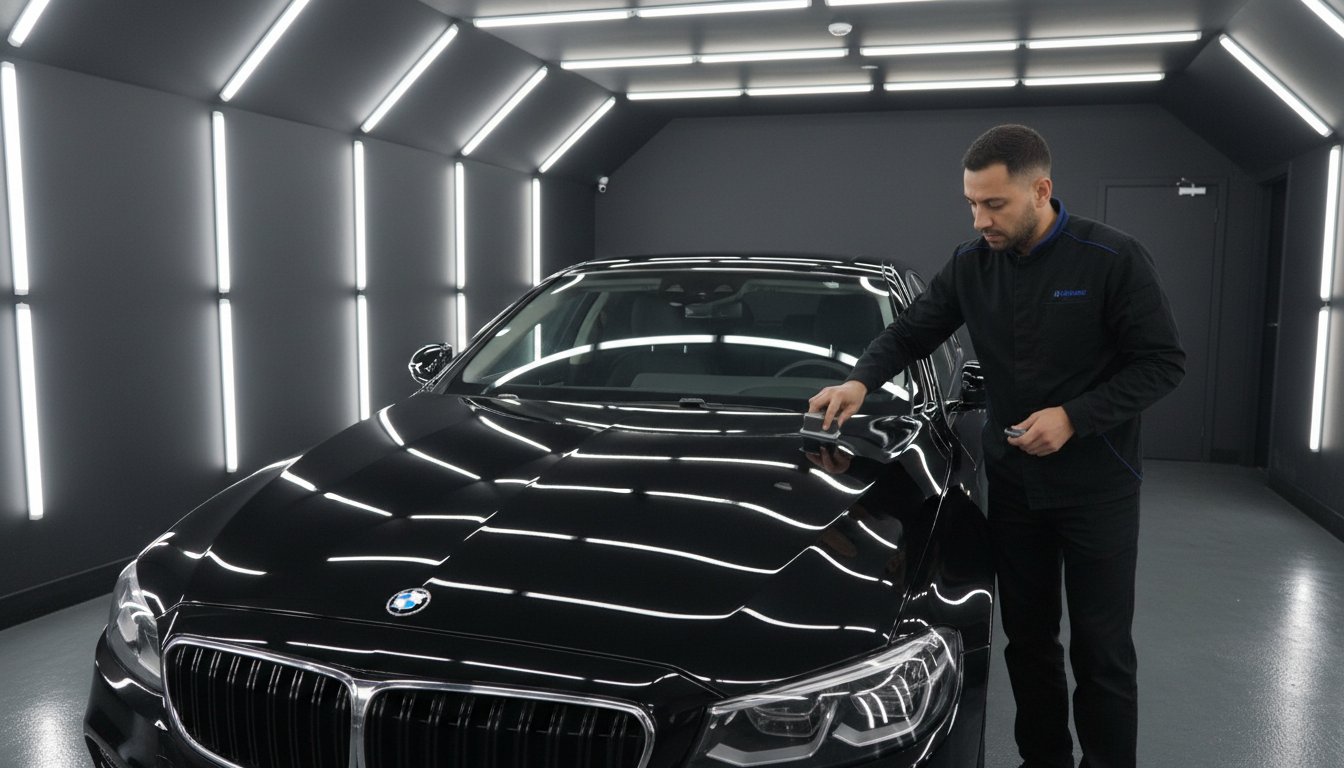
Ceramic Coating for New Cars: Why the Best Time to Protect is Day One
Is your brand-new vehicle actually as "perfect" as it looks under the showroom lights? While the odometer might show nearly zero miles, the factory finish is at its most vulnerable state the moment it encounters the harsh elements outside the dealership lot. You likely feel a deep sense of pride in your new purchase, yet you may also feel a lingering anxiety regarding the first inevitable scratch or the corrosive effects of New Jersey road salt. Investing in a professional ceramic coating for new cars is the most effective way to address these concerns before they become permanent defects in your clear coat.
We understand that you view your vehicle as a significant investment that deserves elite care. This article will demonstrate why day one is the ideal time for protection, as the paint is at its most correctable and ready for long-term preservation. You will discover how our meticulous process creates a permanent showroom shine, makes every wash significantly easier, and secures your car's future resale value. We will also clarify the vital differences between temporary dealership sealants and the elite, professional-grade ceramic protection your vehicle truly deserves.
Key Takeaways
- Uncover why factory paint is often compromised by industrial fallout and rail dust during transport, necessitating immediate professional intervention.
- Explore how a professional ceramic coating for new cars outclasses dealership sealants by providing a durable, high-gloss barrier that resists New Jersey’s intense UV rays.
- Identify the hidden factory defects that only expert paint correction can reveal and rectify to achieve a true showroom-level finish.
- Learn the "no-brush" maintenance philosophy required to preserve your coating's hydrophobic properties against the harsh corrosive effects of winter road salt.
Why Your New Car’s Paint is More Vulnerable Than You Think
Many owners believe their vehicle arrives in flawless condition. It's a common misconception. In reality, the moment a vehicle rolls off the assembly line, its journey toward environmental degradation begins. A professional ceramic coating for new cars acts as a sophisticated shield, bonding at a molecular level to ensure your investment remains pristine. This liquid polymer doesn't just sit on top; it creates a semi-permanent chemical bond with the factory clear coat, providing a level of resilience that traditional waxes cannot match.
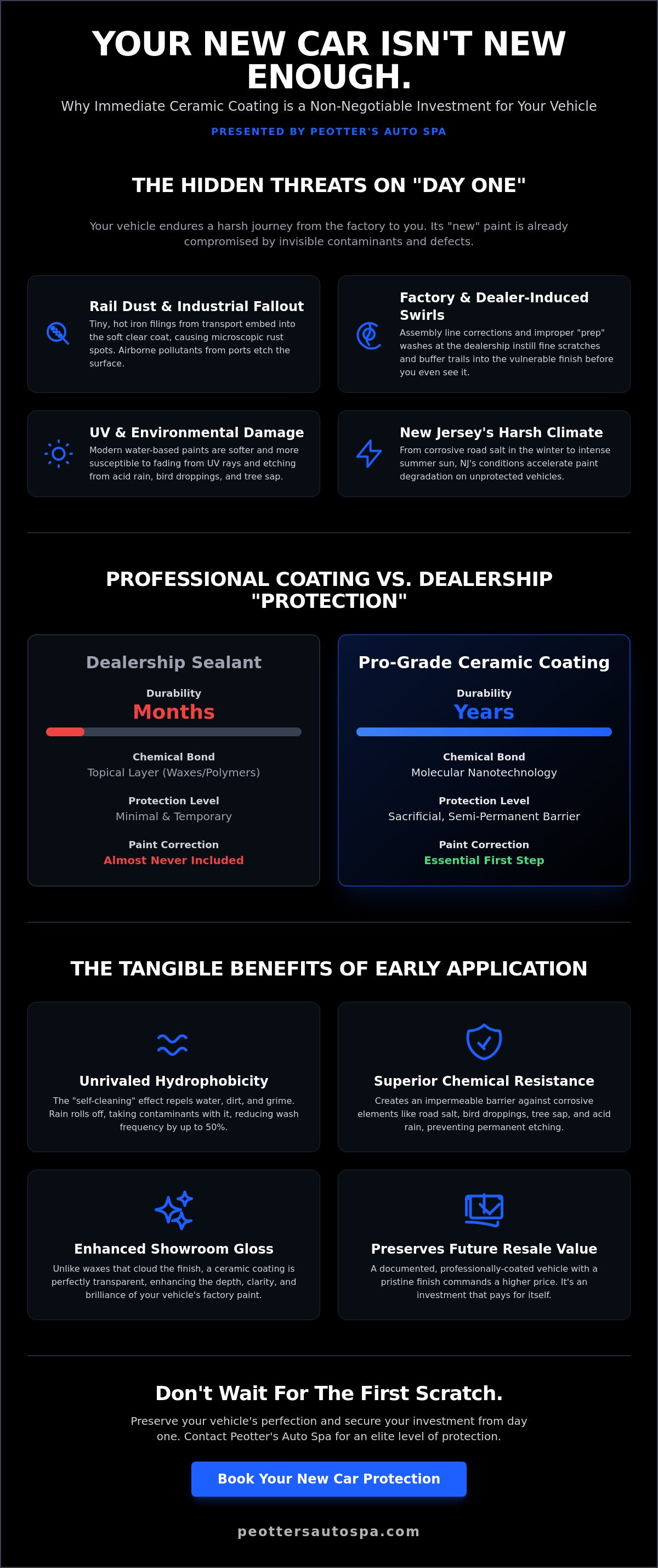
Before you even see the car, it has likely traveled hundreds of miles on open rail cars or transport trucks. During this transit, the paint is bombarded by "rail dust," which are tiny hot iron filings that embed themselves into the soft clear coat. Industrial fallout from shipping ports and holding lots further compromises the surface. Modern automotive finishes are now primarily water-based to meet environmental standards. While better for the planet, these eco-friendly paints are significantly softer and more prone to marring than the solvent-heavy finishes of the past. Protecting this delicate surface early is a matter of economic logic; it's far more cost-effective to preserve a perfect finish than to repair one that has been etched by the elements.
The Reality of "New" Factory Paint
Inspect a "new" car under high-intensity lighting and you will often find a map of imperfections. Even before the first mile is driven, the paint often suffers from several common issues:
- Microscopic iron filings known as rail dust that oxidize and cause tiny rust spots.
- Factory-induced sanding marks and buffer trails from assembly line corrections.
- Transit scratches and swirl marks from improper handling during shipping.
Dealership "prep" teams often exacerbate these issues. They frequently use high-speed brushes or contaminated towels that instill swirl marks into the vulnerable finish. For drivers near Springfield, NJ, the industrial environment adds another layer of risk. Unprotected clear coats are quickly etched by acidic rain and chemical pollutants prevalent in our local atmosphere, making immediate protection essential.
The Science of Chemical Bonding
The efficacy of this treatment lies in nanotechnology. These microscopic particles penetrate and fill the tiny pores of your car’s clear coat, creating a surface that is incredibly smooth and dense. This serves the functional purpose of a coating by creating a barrier against external contaminants. The chemical bond acts as a semi-permanent sacrificial layer that takes the brunt of environmental abuse. Applying a ceramic coating for new cars to "virgin" paint, before it has been weathered or improperly washed, ensures the strongest possible adhesion. This proactive approach locks in a deep, reflective gloss while making future maintenance effortless.
The Tangible Benefits of Early Ceramic Application
Applying a ceramic coating for new cars immediately after purchase transforms the ownership experience from one of constant maintenance to one of effortless preservation. The most striking advantage is unrivaled hydrophobicity. When rain or road spray hits the surface, it beads into tight spheres and rolls away, taking surface contaminants with it. This "self-cleaning" effect is not merely a visual party trick; it effectively reduces your required wash frequency by up to 50%. For the discerning owner, this means more time enjoying the drive and less time laboring over a wash bucket.
The chemical resilience provided by this technology is equally vital for long-term health. In New Jersey, your vehicle faces a gauntlet of stressors, from acidic bird droppings and sticky tree sap in the spring to corrosive road brine in the winter. A professional coating creates an impermeable barrier that prevents these substances from etching into your clear coat. This protection is backed by scientific analysis of car coating materials, which confirms how these advanced polymers resist environmental degradation far more effectively than traditional organic waxes. By sealing the paint on day one, you ensure that the New Jersey summer sun doesn't lead to premature oxidation or color fading.
Preserving the Showroom Aesthetic
A primary goal for any enthusiast is maintaining that elusive "day one" glow. Our ceramic treatments enhance the visual depth and clarity of your paint, making metallic flakes pop with newfound brilliance. Unlike wax that sits on the surface and eventually clouds the finish, a ceramic bond remains perfectly transparent. It provides a permanent high-gloss shine that mimics a fresh wax job every single day. By hardening the surface, the ceramic coating for new cars also helps mitigate the dulling effect caused by micro-marring, ensuring your car’s finish doesn't lose its luster over time.
Long-Term Value and Resale
Beyond the immediate visual rewards, early application is a savvy financial decision. When the time comes to trade in your vehicle or return a lease, a documented history of professional paint protection serves as a powerful testament to the car's condition. Future buyers recognize the value of a finish that has been shielded from the elements since its first mile. When you consider the cost of frequent paint correction or the loss in resale value from faded paint, the investment in a coating pays for itself. For those seeking the pinnacle of protection, our Total Vehicle Preservation Guide 2026 details how combining these services offers an uncompromising safeguard. If you want to secure your vehicle's future, exploring professional preservation services is the first step toward lasting perfection.
Professional Ceramic Coatings vs. Dealership "Protection Packages"
When you finalize your vehicle purchase, the dealership's finance office often presents a "paint protection" add-on as a last-minute convenience. It's vital to understand that these packages typically represent a significant departure from the elite standard of a professional ceramic coating for new cars. While a dealership might offer a quick spray-on sealant, a master craftsman at a boutique spa provides a comprehensive preservation process. The difference begins with the environment; a high-volume dealership service center is often fraught with airborne dust and cross-contamination. In contrast, our controlled, hospital-clean bays ensure that the coating bonds to the paint without interference from the debris of a busy repair shop.
The hands applying the product matter as much as the chemistry itself. Dealerships often task lot attendants or entry-level technicians with these applications. These individuals frequently lack the years of experience and specialized training required to handle high-solids ceramic liquids. A master detailer understands the nuances of different paint systems, ensuring the application is level, uniform, and flawless. You should also examine the warranty transparency of these dealer offers. Many "lifetime" claims are buried in fine print that requires expensive, frequent inspections to remain valid, whereas a professional specialist offers clear, honest expectations based on proven durability.
Chemistry and Durability Differences
The technical disparity is rooted in the concentration of Silicon Dioxide (SiO2). Professional coatings feature a much higher solids content, which creates a thicker, harder, and more resilient barrier. According to this scientific review of automotive coatings, the performance of these materials depends heavily on their chemical structure and the precision of the curing process. We utilize professional-grade infrared (IR) lamps to bake the coating, accelerating the cross-linking process to achieve maximum hardness. Dealerships rarely invest the time or equipment for this critical step, and they almost always skip the essential paint correction required for a permanent bond.
The Value Proposition of Professional Detailers
Choosing a specialist means receiving a solution tailored to your specific vehicle and lifestyle. We analyze the hardness of your car's unique paint system and provide post-application education to ensure your investment remains perfect. At Peotter’s Auto Spa, our white-glove approach begins the moment your new vehicle arrives. We don't just apply a product; we curate a long-term preservation strategy that honors the significance of your investment. This consultative relationship ensures you have a dedicated guardian for your car’s aesthetic value, providing a level of care that a high-volume dealership simply cannot replicate. Our commitment to excellence ensures that your ceramic coating for new cars delivers the visual brilliance and protection you expect.
The Invisible Step: Why New Cars Still Require Paint Correction
The assumption that a factory-fresh vehicle possesses flawless paint is perhaps the most pervasive myth in automotive care. While the odometer may be near zero, the surface has already endured a gauntlet of industrial exposure and assembly-line handling. At Peotter’s Auto Spa, we utilize specialized high-intensity lighting to reveal what the naked eye often misses; sanding marks, factory haze, and microscopic iron deposits are frequently hidden in plain sight. These imperfections act as tiny craters and peaks that disrupt light reflection, stealing the brilliance your car was meant to display.
Achieving a true mirror finish requires meticulous preparation; in fact, roughly 90% of the final gloss is the direct result of precision paint correction rather than the coating itself. If you apply a ceramic coating for new cars over these defects, you are effectively sealing them under a permanent layer of glass. This is why the preparation phase is the most critical part of our process. It's the difference between a car that simply looks clean and one that possesses a deep, liquid-like luster that commands attention. By leveling the paint first, we ensure the final result is nothing short of perfection.
The Decontamination Process
A standard wash is insufficient for the demands of a high-performance ceramic coating for new cars. We begin with a chemical decontamination step, using pH-balanced iron removers to dissolve metallic particles that have embedded themselves into the clear coat during rail transport. This is followed by a clay bar treatment to lift any remaining industrial fallout, ensuring the surface is surgically clean. You must understand that coating over even the smallest contaminants creates a compromised "sandpaper" bond that lacks both the durability and the clarity required for an elite finish.
Precision Paint Correction
Most new vehicles arrive with what we call "Dealer Installed Swirls" (DIS). These are the unfortunate result of hurried pre-delivery inspections where improper wiping techniques leave a web of fine scratches in the soft clear coat. Our master craftsmen perform precision paint correction to level these defects, simultaneously removing factory "orange peel" that can make a finish look textured or blurry. By restoring absolute clarity to the paint, we create the perfectly smooth foundation required for maximum hydrophobicity. This level of refinement ensures the liquid polymer bonds uniformly, allowing water to slide off the surface with zero resistance. To ensure your vehicle receives this meticulous level of care, we invite you to view our paint correction and preservation options.
Preserving Perfection: Maintenance for New Jersey Drivers
Investing in a ceramic coating for new cars is the definitive first step toward lifelong preservation; however, maintaining that elite finish requires a disciplined approach to care. While the coating is incredibly durable, it is not a "set it and forget it" solution. To keep the surface performing at its peak, you must adhere to the "no-brush" rule. Automatic car washes are the primary enemy of automotive perfection. The abrasive, heavy brushes used in high-volume tunnels act like sandpaper, instilling thousands of tiny scratches that gradually dull the deep gloss we worked so hard to achieve during the correction phase.
For at-home maintenance, we advocate for the two-bucket method. This sophisticated technique utilizes one bucket for your pH-neutral soap and a second for rinsing your wash mitt. By separating the two, you ensure that grit and contaminants are never reintroduced to the paint. This methodical ritual preserves the clarity of the coating and prevents the micro-marring that often plagues unprotected vehicles. Annual inspections at our facility are also a vital component of your protection strategy. These visits allow us to deep-clean the coating, remove stubborn bonded contaminants, and ensure the warranty remains in good standing.
Seasonal Protection in Springfield
New Jersey’s climate presents a unique gauntlet of stressors for any vehicle. In Springfield, the winter months bring a heavy application of road brine and magnesium chloride. These chemicals are highly corrosive, yet they slide off a coated surface with ease during a maintenance wash. In the summer, drivers in Summit face intense UV exposure that can lead to paint oxidation. Our ceramic treatments provide a stable barrier against this solar damage. To maintain the signature "slick" feel of the surface, we utilize ceramic-infused toppers during our maintenance services, which replenish the hydrophobic properties and enhance the sacrificial layer.
The Peotter’s Auto Spa Experience
At Peotter’s Auto Spa, our meticulous process for new car arrivals is designed to exceed the expectations of the most discerning enthusiasts. We believe in a holistic approach to vehicle preservation. You can further safeguard your investment by complementing your coating with Premium Window Tint, which provides total UV protection for your interior and enhances the overall aesthetic of your vehicle. Our Springfield studio is a sanctuary for automotive excellence, where every detail is handled with "white-glove" precision. Your new car is a significant investment; it deserves the protection of a master craftsman. Schedule your new car consultation today to secure the permanent showroom shine your vehicle was meant to have.
Secure Your Vehicle's Legacy of Perfection
Your new car is more than a means of travel; it's a significant investment that deserves the highest standard of preservation. By choosing a professional ceramic coating for new cars on day one, you effectively bypass the damage caused by industrial fallout and New Jersey's corrosive environment. You aren't just buying a product; you are securing a future of effortless maintenance and unrivaled visual depth. As precision paint correction specialists, we ensure that every imperfection is rectified before it is sealed beneath a durable, high-gloss barrier.
Since 1994, Peotter’s Auto Spa has operated as a family-owned destination for automotive excellence. Our team consists of authorized installers of premium 9H coatings who treat every vehicle with the meticulous care of a master craftsman. Don't settle for the temporary solutions offered by high-volume dealerships. Instead, trust your vehicle to dedicated specialists who share your passion for automotive perfection. We invite you to experience the peace of mind that comes with elite, white-glove service. Protect Your New Investment: Request a Ceramic Coating Quote today and enjoy a permanent showroom shine for years to come.
Frequently Asked Questions
Is ceramic coating worth it on a brand-new car?
Yes, investing in this protection immediately is the most effective way to preserve your vehicle's factory finish before environmental degradation begins. By sealing the paint on day one, you lock in the absolute clarity of the clear coat and prevent acidic etching from bird droppings or industrial fallout. It is a proactive choice that secures both the aesthetic brilliance and the future resale value of your significant investment.
How long does a professional ceramic coating last on a new car?
A professional-grade application typically provides durable protection for two to seven years, depending on the specific formula and your maintenance habits. Some advanced professional coatings emerging in 2026 even offer durability ratings of up to 15 years. This longevity far exceeds traditional waxes or dealership sealants, which often fail within a few months of exposure to the elements.
Does ceramic coating prevent rock chips?
No, a ceramic coating is designed to provide chemical and UV resistance rather than physical impact protection. While it creates a hard, sacrificial layer that resists fine swirl marks and light abrasions, it cannot stop the force of a stone at highway speeds. For those seeking defense against rock chips, we recommend combining a coating with paint protection film (PPF) for total surface security.
Can I apply ceramic coating myself to a new car?
While consumer-grade kits are available, they lack the high SiO2 concentration and long-term resilience of professional-grade products. The most significant risk of DIY application is the lack of precision paint correction; applying a coating without professional leveling will permanently seal factory defects and contaminants under the surface. Our meticulous process ensures the paint is surgically clean and flawless before the chemical bond is established.
How do I maintain my ceramic coating in the New Jersey winter?
Maintaining a ceramic coating for new cars during a Northeast winter requires regular removal of road salt and magnesium chloride. You should utilize touchless wash methods or the two-bucket hand wash technique to avoid instilling scratches. Regular maintenance prevents these corrosive chemicals from sitting on the surface, ensuring the hydrophobic properties remain active even in the harshest freezing conditions.
Will ceramic coating void my vehicle’s factory paint warranty?
No, applying a professional coating will not void your manufacturer's paint warranty. In fact, most manufacturers encourage proactive paint preservation. Because a ceramic treatment is a non-invasive enhancement that sits on top of the clear coat, it is viewed as a superior form of maintenance that actually helps the paint meet its expected lifespan by preventing premature oxidation and failure.
How soon after buying a new car should I get it coated?
The ideal time to apply a ceramic coating for new cars is the very day you take delivery from the dealership. Securing the finish before it encounters road brine, rail dust, or improper washing ensures the strongest possible chemical bond. This "day one" approach minimizes the amount of paint correction required and ensures your vehicle never spends a single day without elite protection.