Ceramic Window Tint: The Ultimate Guide to Luxury Automotive Protection
Imagine sliding into your driver's seat on a humid July afternoon in Springfield, only to find the cabin air thick and the leather upholstery radiating a punishing heat. You've likely felt that frustration where your air conditioning struggles against the sun, while the quiet worry of UV rays fading your pristine interior lingers in the back of your mind. Upgrading to a professional ceramic window tint transforms this experience, moving beyond simple aesthetics into the realm of elite automotive preservation and daily comfort.
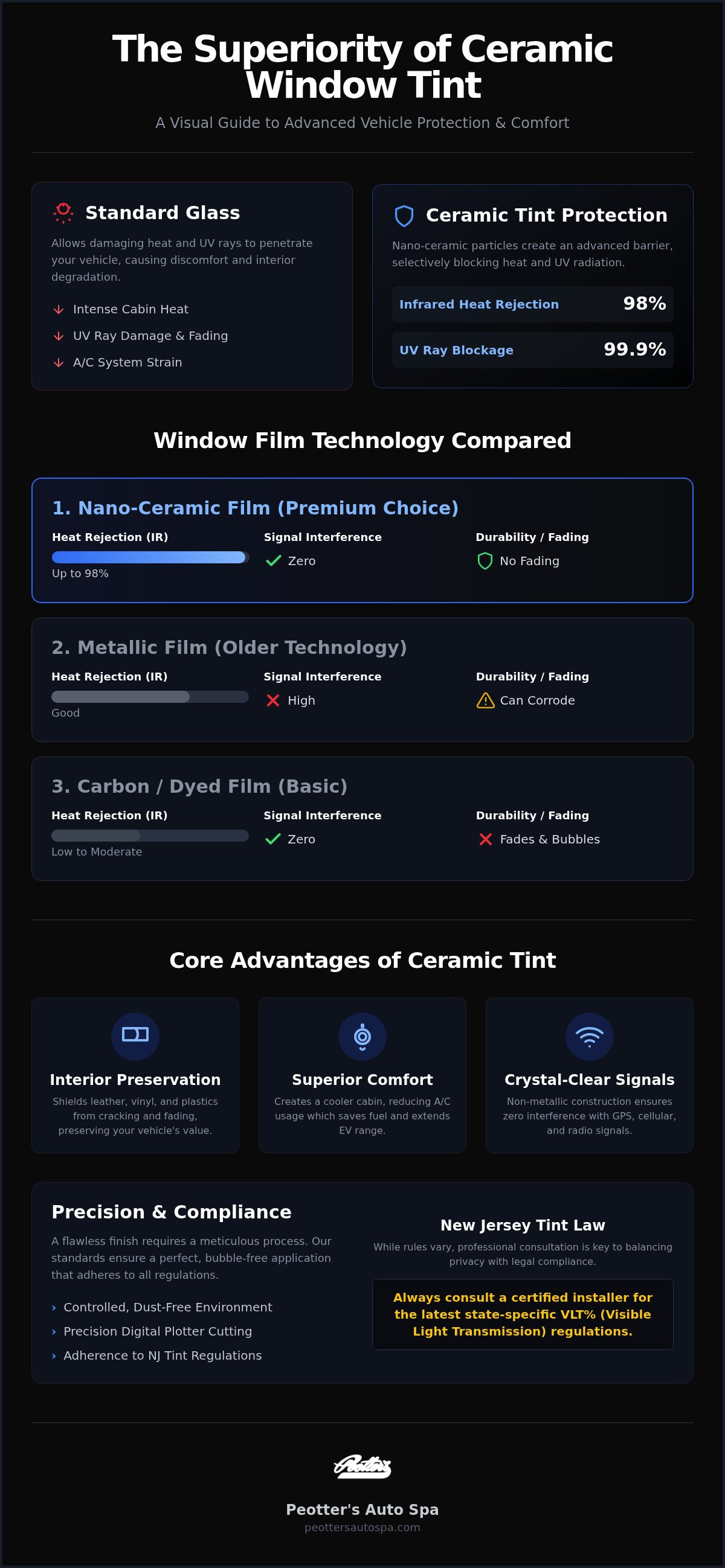
We understand that your vehicle is a significant investment that deserves a meticulous level of care. This guide explores how advanced nano-ceramic technology rejects up to 98% of infrared heat and 99.9% of UV rays while ensuring your GPS and mobile signals remain crystal clear. You'll learn about the specific performance advantages of these high-end films, navigate the complexities of 2026 New Jersey window tint regulations, and discover why this upgrade is a vital component of a sophisticated vehicle protection plan.
Key Takeaways
- Understand how advanced nano-ceramic particles create a non-metallic barrier that blocks heat without disrupting your vehicle's sophisticated electronic systems.
- Discover the science of total infrared rejection, which shields your cabin from up to 99.9% of harmful UV rays to preserve the integrity of your luxury leather interior.
- Learn why ceramic window tint represents the ultimate upgrade over older metallic films by providing crystal-clear signal connectivity for GPS and mobile devices.
- Navigate the 2026 New Jersey tinting regulations to select a shade that balances personal privacy with strict legal compliance for passenger vehicles and SUVs.
- Identify the meticulous installation standards required for a flawless finish, including the importance of a controlled environment and precision digital cutting.
The Evolution of Window Protection: What is Ceramic Window Tint?
Automotive window film has undergone a remarkable transformation since its inception. The Evolution of Window Protection has moved from basic aesthetic shading to high-performance heat management. In the past, vehicle owners had to choose between dyed films that eventually faded to purple or metallic films that blocked vital electronic signals. Today, ceramic window tint represents the pinnacle of this technology. It utilizes non-conductive, non-metallic ceramic particles that are so small they are invisible to the naked eye. This advanced material provides a sophisticated barrier against the elements without compromising the vehicle's appearance or its complex internal systems.
By 2026, this technology has firmly established itself as the gold standard for luxury vehicle preservation. It's no longer just about privacy; it's about creating a controlled, protected environment within the cabin. Unlike older technologies that relied on heavy pigments to block light, ceramic films offer "invisible" protection. This means you can achieve world-class heat rejection even with a film that looks nearly clear, maintaining the original design intent of your vehicle's glass while gaining all the functional benefits of a high-end shield.
The Nano-Ceramic Difference
The secret to this performance lies in the microscopic engineering of the film. These nano-ceramic particles are specifically tuned to absorb infrared radiation and ultraviolet rays before they ever enter your car. Because these particles are inorganic, they don't break down or discolor when exposed to the sun's relentless energy. You won't experience the bubbling or peeling common with entry-level products. Instead, you get a durable finish that maintains its optical clarity and reduces harsh glare. This ensures a safer, more comfortable driving experience during those bright New Jersey afternoons.
Why Modern Vehicles Demand Advanced Film
Modern luxury cars and Electric Vehicles (EVs) are essentially rolling computers. They feature expansive glass roofs and sensitive digital dashboards that are highly vulnerable to thermal stress. Traditional metallic films often interfere with the complex antenna arrays used for GPS, Bluetooth, and cellular connectivity. Using a premium ceramic window tint solves this issue entirely. Because the film is non-conductive, it allows every electronic signal to pass through flawlessly. At Peotter’s Auto Spa, we see this as an essential component of a complete protection strategy. It safeguards the delicate infotainment screens and premium leather upholstery that define your vehicle's interior, ensuring your investment remains in pristine condition for years to come.
Total Infrared Rejection: The Science of Keeping Your Interior Cool
Many drivers mistakenly believe that a darker window shade is the primary factor in keeping a vehicle cool. However, visible light is only one part of the thermal equation. The primary source of cabin heat is actually invisible infrared radiation. The Science of Keeping Your Interior Cool relies on spectrally selective technology that filters out these heat-carrying wavelengths before they penetrate your glass. It's a sophisticated solution that safeguards both your physical comfort and your vehicle's long-term resale value. Total Solar Energy Rejection (TSER) is the most accurate metric for measuring tint performance because it accounts for the cumulative rejection of ultraviolet, visible, and infrared energy.
TSER and Infrared Radiation Explained
High-end ceramic window tint can reject up to 98% of infrared heat, creating a noticeably more temperate environment from the moment you slide into the driver's seat. This thermal barrier provides immediate "AC relief," allowing your climate control system to reach your desired temperature faster and maintain it with significantly less effort. This reduction in mechanical strain is particularly beneficial for modern engines and electric vehicle batteries. By lowering the energy demand of the air conditioning unit, you effectively preserve your fuel efficiency, reduce component wear, and extend your EV's driving range during the most intense NJ summer days.
When we evaluate film performance at Peotter's Auto Spa, we focus on how these microscopic ceramic layers work to dissipate heat rather than simply absorbing it. Standard films often trap heat within the glass, which eventually radiates into the cabin. In contrast, premium ceramic technology reflects a vast majority of that energy away from the vehicle. This results in a cabin that stays 25-30°F cooler than a car with untreated windows, providing a serene and climate-controlled sanctuary regardless of the external temperature.
Preserving Luxury Interiors from UV Damage
The sun's impact on a luxury cabin is both thermal and chemical. While infrared light brings the heat, ultraviolet rays are responsible for the slow, destructive degradation of premium materials. Professional ceramic films offer the equivalent of SPF 1000 protection, blocking 99.9% of UV rays that would otherwise cause leather to crack, wood trim to bleach, and delicate plastics to become brittle. This level of meticulous care ensures that the rich textures, supple feel, and vibrant colors of your interior remain in showroom condition for years to come.
For owners who view their vehicle as a masterpiece, protecting the interior is just as vital as maintaining the paint. Combining advanced window protection with our Ultimate PPF and Ceramic Coating Package NJ provides a comprehensive defense for every surface of your investment. If you're ready to elevate your driving experience, we invite you to speak with our expert team about tailoring a protection plan that matches your standards of excellence.
Ceramic vs. Carbon and Metallic Tints: Why the Upgrade Matters
Selecting the right film tier is more than a matter of darkness; it's a decision about the functional integrity of your vehicle. While the market offers various levels of protection, the differences between dyed, metallic, carbon, and ceramic films are profound. Dyed films are largely cosmetic, offering minimal heat rejection and a tendency to degrade quickly. Metallic films provide better thermal performance but introduce significant technical compromises. For the discerning owner, understanding these distinctions is the first step in ensuring a high-return investment for their vehicle's preservation.
Carbon films represent a mid-tier improvement, utilizing carbon particles to block about 40% of infrared radiation. While they don't fade like dyed films, they still fall short of the elite performance offered by a professional ceramic window tint. Ceramic technology remains the only solution that achieves superior heat rejection without the drawbacks of its predecessors. It's a choice that prioritizes both cabin comfort and the long-term aesthetic perfection of your glass.
Signal Clarity: No More Dropped Calls or GPS Lag
One of the most frustrating aspects of older metallic films is their tendency to act like a Faraday cage. Because these films contain actual metal particles, they reflect more than just heat; they bounce back radio frequencies, GPS signals, and cellular data. In an era where modern luxury vehicles rely on 5G connectivity and satellite-linked navigation, this interference is unacceptable. It can lead to dropped calls, lagging maps, and poor reception in areas where your phone should otherwise have full bars.
Ceramic films are entirely non-conductive and non-metallic. This ensures that your mobile devices, keyless entry systems, and integrated Wi-Fi hotspots operate at peak efficiency. Beyond signal strength, advanced driver-assist technologies (ADAS) often rely on clear communication between sensors and external networks. By choosing a ceramic-based solution, you guarantee that your vehicle's sophisticated electronic nervous system remains unburdened and fully operational.
Durability and Color Stability Over Time
The sight of a high-end car with bubbling, purple-tinted windows is a tragedy of poor material choice. That purple hue occurs when the cheap dyes in entry-level films break down under constant UV exposure. High-performance ceramic particles are inorganic, meaning they're naturally stable and immune to this type of chemical degradation. They won't lose their color or their ability to block heat, even after years of exposure to the intense New Jersey sun.
In addition to color stability, premium ceramic films feature robust, scratch-resistant coatings. This protection ensures that the frequent movement of windows doesn't result in unsightly vertical streaks or surface hazing. At Peotter's Auto Spa, we're committed to a white-glove standard, which means we only install films that meet our criteria for long-term resilience and flawless clarity. It's a meticulous approach that ensures your vehicle looks as impeccable five years from now as it does the day it leaves our Springfield facility.
Selecting Your Tint Profile: Shades, Clarity, and NJ Legal Compliance
Choosing the ideal shade for your vehicle is a delicate balance between personal privacy, aesthetic harmony, and strict adherence to local regulations. While the visual transformation is often the most immediate result, the technical profile of the film determines how your vehicle performs in the varied light conditions of the Northeast. A common misconception persists that a darker film inherently provides better defense against the sun. In reality, a high-quality ceramic window tint provides elite thermal rejection even in its most transparent forms, allowing you to prioritize visibility without sacrificing cabin comfort.
The selection process should consider your vehicle's specific color palette. A deep charcoal tint often complements a metallic exterior, while lighter shades can maintain the airy, open feel of a luxury cabin with panoramic glass. At Peotter’s Auto Spa, we view this as a collaborative design process. We help you evaluate how different percentages interact with your interior upholstery, as light-colored leather can make a tint appear lighter than it would against a black cabin.
Understanding VLT (Visible Light Transmission)
VLT is the standard metric used to categorize the darkness of a film, representing the percentage of visible light that passes through the glass. A 5% VLT, often referred to as "limo tint," offers maximum privacy and a bold, aggressive look. Conversely, a 35% or 50% VLT provides a sophisticated, factory-plus appearance that reduces glare while maintaining excellent night-time visibility. For owners who want the benefits of heat rejection without changing the look of their glass, a 70% ceramic film is a revelation. This nearly clear option is the perfect choice for full windshield protection, blocking massive amounts of solar energy while remaining virtually invisible to the eye.
Navigating New Jersey Window Tint Laws in 2026
Compliance is a critical pillar of our "white-glove" service. As of July 2026, New Jersey maintains some of the most specific window tint regulations in the country. It's essential to understand these boundaries to avoid unnecessary citations or inspection failures:
- Front Windshield: No aftermarket tint is permitted on the main body of the glass. You may apply a non-reflective strip along the top 6 inches, staying above the AS-1 line.
- Front Side Windows: For passenger cars, New Jersey law prohibits any aftermarket film on the driver and front passenger windows.
- Rear Side and Rear Windows: On passenger sedans, aftermarket film is technically restricted. However, for SUVs and vans, New Jersey allows any darkness on the rear side and back windows, provided the vehicle has dual side mirrors.
- Colors and Reflectivity: Mirrored or metallic finishes are strictly banned, as are red, amber, and yellow tints.
We help our clients navigate these rules by offering high-performance clear ceramic options that provide the protection you need while respecting legal limits. If you are unsure which shade best fits your lifestyle and your vehicle's legal profile, we invite you to consult with our Springfield specialists for a personalized recommendation.
The Peotter’s Standard: Precision Installation in Springfield, NJ
The ultimate performance of high-end film is entirely dependent on the caliber of its installation. At Peotter’s Auto Spa, we approach every vehicle with the mindset of a meticulous master craftsman. Being family-owned and operated since 1994, we understand that luxury automotive preservation is a matter of trust and precision. While high-volume shops often prioritize speed, our boutique-style center focuses on a "white-glove" experience that ensures every edge is seamless and every surface is flawless. We treat your vehicle as the significant investment it is, providing a level of care that transforms a simple service into a long-term rejuvenation.
Why Professional Environment Matters for Ceramic Film
The application of ceramic window tint requires a sterile, climate-controlled environment to achieve an optically perfect result. Even microscopic dust particles can cause unsightly nibs or bubbling if they become trapped beneath the film during installation. Our Springfield facility utilizes a dedicated clean-room environment where temperature and humidity are strictly regulated. This controlled setting prevents contamination and allows the adhesive to cure with absolute clarity, ensuring that your view of the road remains sharp and undisturbed.
Beyond cleanliness, the technical complexity of modern exotic and luxury car glass demands expert-level skill. Many high-performance vehicles feature complex compound curves that require advanced heat-shrinking techniques to ensure the film conforms perfectly without distorting. Our specialists are trained to handle these intricate shapes with patience and precision. Throughout the process, we maintain a rigorous standard of interior protection, using specialized covers and moisture barriers to safeguard your delicate electronics and premium upholstery from the installation fluids.
Integrating Tint with PPF and Ceramic Coatings
For the discerning owner, window protection is often the final piece of a comprehensive preservation strategy. A professional tint completes the aesthetic and functional profile of a vehicle already treated with Ceramic Coating. While the coating preserves the brilliance of your paint, the tint provides the thermal barrier and UV shield necessary to protect the cabin. This "Total Protection" approach ensures that every surface of your car, from the external clear coat to the internal leather, is resilient against the elements.
Every vehicle that enters our care undergoes a multi-point final inspection to ensure it meets our uncompromising standards for excellence. We invite you to view your next upgrade as part of a broader Premium Window Tint in Summit, NJ experience. By combining elite materials with our decades of specialized expertise, we provide a result that is durable, visually stunning, and deeply reassuring. Your journey toward a cooler, more private, and better-protected driving experience begins with a consultation at our Springfield expert center.
Elevate Your Driving Experience with Elite Protection
Investing in a professional ceramic window tint is a decision that pays dividends in both daily comfort and long-term vehicle preservation. We've explored how this advanced technology rejects up to 98% of infrared heat while ensuring your GPS and mobile connectivity remain flawless. By prioritizing non-metallic materials and precision installation, you safeguard your luxury cabin from the destructive effects of UV rays and the intense heat of New Jersey summers.
Since 1994, Peotter’s Auto Spa has served as a trusted guardian for NJ automotive enthusiasts. Our boutique Springfield facility utilizes a meticulous clean-room process specifically designed for the unique requirements of exotic and high-end vehicles. As specialists in luxury protection, we ensure that every edge is seamless and every film is applied with uncompromising standards. We invite you to experience the peace of mind that comes from placing your vehicle in the hands of dedicated master craftsmen.
Ready to transform your vehicle into a climate-controlled sanctuary? Schedule Your Premium Ceramic Tint Consultation at Peotter's Auto Spa today. We look forward to helping you achieve the perfect balance of privacy, protection, and sophisticated performance.
Frequently Asked Questions
Is ceramic window tint worth the extra money?
Yes, it's a superior investment for long-term vehicle preservation and daily comfort. Ceramic films offer much higher Total Solar Energy Rejection (TSER) than standard carbon or dyed alternatives, rejecting up to 98% of infrared heat. You'll notice a significant drop in cabin temperature, which reduces the workload on your climate control system and protects your interior materials from thermal stress.
How long does it take to install ceramic window tint?
A professional installation typically requires two to four hours depending on the size and complexity of your vehicle. We dedicate the necessary time for meticulous glass decontamination and precision digital cutting in our Springfield facility. Complex exotic vehicles with curved glass may require a slightly longer window to ensure our white-glove standards are met with absolute perfection.
What is the legal window tint limit in New Jersey for 2026?
New Jersey law prohibits any aftermarket tint on the front side windows of passenger vehicles as of July 2026. You're permitted to tint the rear side and back windows of SUVs and vans to any darkness level. For passenger cars, regulations are stricter regarding rear glass, so we always recommend a consultation to ensure your specific profile remains fully compliant with state requirements.
Can ceramic tint interfere with my car's GPS or cell signal?
No, ceramic films are specifically engineered to be non-metallic and non-conductive. This ensures that your GPS, mobile data, and Bluetooth signals pass through the glass with zero interference. It's the premier choice for modern luxury vehicles and EVs that rely on 5G connectivity and advanced driver-assist systems to function at peak performance.
How long should I wait to roll down my windows after tinting?
We recommend waiting at least three to five days before rolling down your windows. This period allows the specialized adhesive to cure completely and create a permanent bond with the glass. During humid New Jersey months, we might advise a slightly longer duration to guarantee that the film stays perfectly positioned without any shifting or peeling.
Does ceramic window tint prevent the interior from fading?
Yes, ceramic films provide a powerful defense against the chemical breakdown of your cabin materials. By blocking 99.9% of harmful ultraviolet rays, the film prevents leather from cracking and wood trim from losing its vibrant luster. It acts as a high-end shield that preserves the showroom quality of your vehicle's most delicate and expensive interior components.
Can you tint the windshield with ceramic film legally?
New Jersey law only allows aftermarket tint on the top six inches of the windshield, staying above the AS-1 line. While many owners utilize clear 70% ceramic films for their incredible heat rejection properties, the main body of the windshield must technically remain free of aftermarket film. We help you maximize your protection within these legal boundaries to ensure a safe and compliant driving experience.
How do I clean my ceramic tinted windows?
Cleaning is simple but requires an ammonia-free glass cleaner and a soft microfiber towel. You should avoid any abrasive materials or harsh chemicals that could scratch the surface or degrade the adhesive. Standard ammonia-based cleaners can eventually cloud or weaken the ceramic window tint, so using mild, specialized products is the best way to maintain its flawless optical clarity for years.