How Long Does PPF Last? A Guide to Paint Protection Film Longevity in 2026
If you knew that 300,000 tons of rock salt and 1.7 million gallons of brine hit New Jersey roads every winter, would you still trust a standard warranty to keep your vehicle flawless? It is a common concern for owners of high-end automobiles who fear that their protective film might yellow, crack, or fail under the pressure of these corrosive elements. You want to know exactly how long does ppf last when faced with real-world conditions rather than just laboratory tests. We understand that your vehicle is a significant investment that deserves more than just a temporary solution; it requires a meticulous strategy for long-term preservation and resilience.
This guide reveals the expert secrets to making your vehicle's armor last for a decade or more. You will gain total confidence in a 10 year protection plan by understanding the synergy between chemical grade, installation precision, and regional maintenance. We will explore the latest advancements in TPU-based films, the hydrophobic benefits of ceramic-infused technology, and the specific steps you can take to maintain a pristine, glass-like finish. By the end of this article, you will have a clear roadmap to ensuring your car remains in a state of perpetual perfection.
Key Takeaways
- Learn why 10 year warranties have become the benchmark for professional grade preservation in the current automotive landscape.
- Discover exactly how long does ppf last when facing the harsh reality of New Jersey's corrosive road salts and intense UV exposure.
- Understand the critical role of precision installation techniques, such as tucked edges, in ensuring your vehicle's armor remains seamless and secure.
- Gain expert knowledge on the specific hand-washing protocols and chemical safety rules that extend the life of your film's pristine finish.
- Recognize the precise visual indicators that signal when it's necessary to perform a proactive removal to maintain your investment's value.
The Industry Standard: How Many Years Does PPF Really Last?
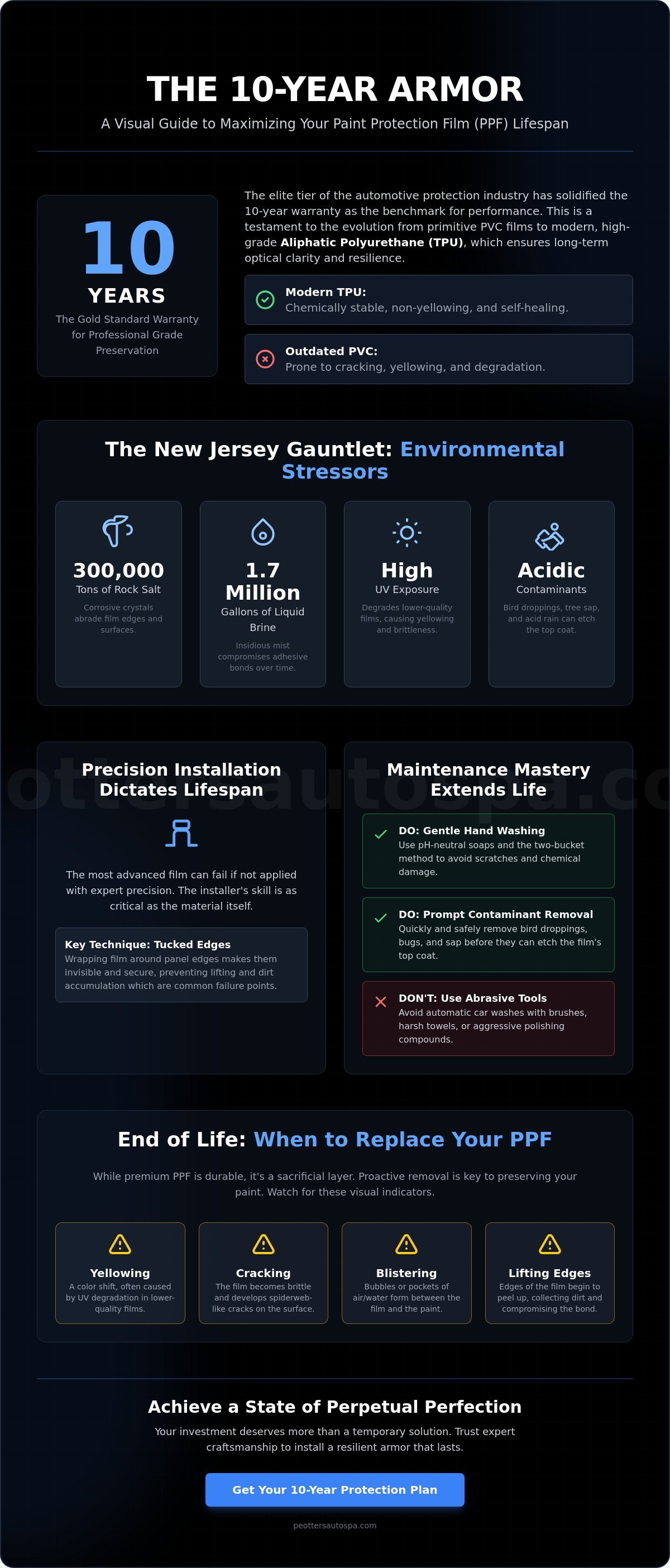
In the pursuit of automotive perfection, the question of how long does ppf last has shifted from a concern about simple survival to a demand for enduring invisibility. By 2026, the elite tier of the industry has solidified the 10-year warranty as the gold standard for performance. This benchmark isn't merely a marketing promise; it's a testament to the significant evolution in polymer science. Modern Paint Protection Film has moved far beyond the primitive PVC constructions of the past. Today, the use of high-grade Aliphatic Polyurethane ensures that the film remains stable and transparent even after years of intense environmental exposure.
The aging curve of your vehicle's armor depends heavily on its lifestyle. A "garage queen" that only emerges for weekend exhibitions will naturally maintain its showroom brilliance longer than a high-mileage daily driver. For the commuter vehicle, the film faces a relentless barrage of industrial fallout, road debris, and seasonal temperature swings. While the underlying chemistry is designed for long-term resilience, these daily stressors dictate how long does ppf last before the surface requires specialized attention. Precision in both the selection of the film and the meticulousness of its application determines whether your car looks pristine at year five or year ten.
Functional vs. Aesthetic Longevity
There's a vital distinction between a film that still stops rock chips and one that still looks beautiful. A film can remain structurally sound while its surface begins to show the weight of its service. We define true PPF lifespan as the period where the material remains optically clear and physically pliable. The sophisticated top coat is responsible for that signature "wet look" and self-healing capability. Over a decade, this layer may eventually lose some of its luster even if the physical barrier remains intact. Consistent, professional-grade care is the secret to extending this aesthetic peak, ensuring the film continues to enhance the vehicle's depth and clarity.
Warranty Realities: What 10 Years Actually Covers
A 10-year warranty offers a deep sense of reassurance, but it's essential to understand the specific protections it provides. These manufacturer agreements are designed to guard against structural failures such as yellowing, cracking, and blistering. They're a guarantee of the film's chemical integrity rather than a shield against every possible road hazard. It's also important to remember that a warranty is only as reliable as the specialist who stands behind the work. By partnering with a dedicated craftsman, you ensure that any potential issues are addressed with the same level of care and precision that went into the initial installation.
Environmental Stressors: Why NJ Roads Test PPF Durability
New Jersey drivers face a unique gauntlet that directly impacts how long does ppf last. Our state's heavy reliance on road salt and liquid brine creates a highly corrosive environment that tests the structural integrity of even the most premium films. During a typical winter, the New Jersey Department of Transportation deploys 300,000 tons of rock salt and 1.7 million gallons of liquid brine. This chemical cocktail doesn't just sit on the surface; it actively seeks out the edges of your film, attempting to compromise the adhesive bond and cloud the finish over time.
Beyond the winter chill, the Northeast summer brings its own set of invisible enemies. High UV exposure can degrade lower-quality thermoplastic polyurethane, leading to the brittle texture or yellowing seen in economy products. These factors significantly influence how long does ppf last on a vehicle that spends its days parked in direct sunlight. Industrial fallout and acid rain further complicate the preservation process, as microscopic metallic particles can embed themselves into the film's surface. Even organic contaminants like tree sap or bird droppings pose a threat; their acidic nature can etch the top coat if they aren't neutralized quickly.
The Road Salt Factor
Liquid brine containing magnesium chloride is particularly insidious because it remains in a liquid state longer than traditional rock salt. For Springfield drivers, this means the vehicle is constantly bathed in a corrosive mist during highway commutes. If left to dry, salt crystals act as harsh abrasives against the film's edges, potentially leading to lifting or dirt accumulation. A gentle, high-pressure rinse to clear these deposits is essential for maintaining that flawless, "white-glove" appearance throughout the winter months.
Temperature Fluctuations and Expansion
The dramatic freeze-thaw cycles of the New Jersey climate force the film to expand and contract repeatedly. Premium films are engineered with the elasticity to handle these shifts without losing their shape or clarity. It's also vital to understand that the self-healing properties of a high-end film require a specific temperature threshold to activate. Whether through the warmth of the sun or a controlled heat source, this thermal reaction is what allows minor swirl marks to vanish. Ensuring your vehicle receives professional paint protection film installation is the first step in guaranteeing it can withstand these environmental extremes.
The Installation Variable: Why Precision Dictates Lifespan
The longevity of your vehicle's armor is as much a product of the installer's hands as it is the film's chemistry. While owners frequently ask how long does ppf last based on the manufacturer's rating, the true answer often depends on what happens before the film even touches the paint. A flawless application requires a sterile environment and a level of patience that high-volume shops simply cannot afford. When you choose a boutique specialist, you are investing in a process where every microscopic detail is scrutinized to ensure the bond remains absolute for a decade or more.
Surface preparation is the most critical phase of the entire journey. We believe the first four hours of meticulous cleaning determine the next ten years of the film's life. This stage involves the total removal of factory waxes, transport oils, and iron deposits that can compromise the adhesive. If any contaminants remain, the film will fail to bond correctly, leading to lifting or "silvering" where the material pulls away from the surface. A dust-free environment is non-negotiable; even a single stray fiber can create an air pocket that eventually expands into a visible bubble.
Paint Correction: The Foundation of Adhesion
Applying protective film over swirls or scratches is a recipe for premature delamination. These surface imperfections create a microscopic "unevenness" that prevents the adhesive from making 100% contact with the clear coat. This is why expert paint correction is an essential prerequisite for any premium installation. By leveling the paint to a mirror-like finish, we create a chemically pure surface for the film to anchor to. This deep bond is what allows the film to resist the high-pressure washes and seasonal temperature shifts that New Jersey drivers face daily.
Custom Bulk vs. Pre-Cut Kits
The method of application also dictates how long does ppf last before showing signs of wear. Many shops rely on pre-cut kits that leave exposed seams and edges near the corners of panels. These gaps are magnets for road salt and dirt, which eventually work their way under the film and cause it to peel. At Peotter's, we focus on custom-trimmed, "bulk" installations. By manually wrapping and tucking the edges behind the body panels, we eliminate the seams entirely. This seamless integration provides a superior aesthetic and ensures there are no entry points for moisture or debris to compromise the adhesive.
Precision also prevents the risk of "stretch marks" or thinning. Over-stretching the film to fit a complex curve thins the protective layer and weakens the top coat's self-healing properties. A master craftsman understands the tension limits of the material, ensuring the film remains thick and resilient across every contour of your vehicle.
Maintenance Mastery: How to Extend Your PPF's Life
While the engineering behind modern films is remarkable, the active role of the owner remains the most significant variable in determining how long does ppf last. You shouldn't view paint protection film as a maintenance-free shield; instead, it's a high-performance surface that thrives under meticulous care. By adopting a "white-glove" approach to cleaning, you preserve the film's structural integrity and ensure its visual perfection remains untarnished for years to come. This commitment to preservation turns a standard installation into a decade-long investment in excellence.
The golden rule of preservation is simple: avoid automated car washes at all costs. The aggressive brushes and recycled water of commercial tunnels are the primary enemies of film longevity. These systems introduce microscopic swirl marks and can catch the edges of the film, leading to premature lifting or peeling. We advocate for a dedicated hand-washing routine or high-quality touchless systems that respect the delicate top coat of your vehicle's armor. This gentle approach maintains the film's clarity, gloss, and self-healing properties.
The PPF + Ceramic Coating Advantage
In 2026, the elite standard for vehicle preservation is the "Synergy Stack." By applying a professional-grade ceramic coating over your film, you create a permanent sacrificial layer that guards the PPF's top coat from environmental degradation. This combination dramatically reduces surface tension, making it nearly impossible for water spots, bird droppings, or industrial fallout to bond with the surface. You can read more about our PPF and ceramic coating packages to see how this dual-layer approach maximizes both depth and resilience.
Safe Washing Techniques for Film
Mastering the art of the wash requires the right tools and a patient, methodical touch. We recommend a foam cannon approach paired with the traditional two-bucket method to minimize physical contact with the film. This process encapsulates dirt particles in a thick lather, allowing them to be rinsed away without marring the surface. If you use a pressure washer, follow these professional guidelines:
- Maintain a distance of at least 12 inches between the nozzle and the film's edges.
- Use a wide-angle spray pattern to distribute pressure evenly across the panel.
- Avoid pointing the stream directly at seams or tucked corners to prevent lifting.
Chemical safety is equally paramount for those wondering how long does ppf last. You must avoid petroleum-based waxes and harsh degreasers, as these can yellow the film or compromise the adhesive bond over time. Instead, utilize dedicated "PPF Renew" cleaners designed to lift embedded grime while keeping the material pliable and healthy. If you notice minor surface "scars" or swirl marks, you can safely trigger the self-healing process with a gentle application of warm water or by simply leaving the vehicle in the direct sun. For those seeking the ultimate in long-term visual enhancement, exploring our ceramic coating options can provide that final, flawless layer of security.
End of Life: When Should You Remove or Replace PPF?
Every high-performance shield eventually reaches the end of its service life. While we've explored the variables that dictate how long does ppf last, recognizing the precise moment for retirement is essential to preserving the underlying paint. When a film has fulfilled its duty of absorbing ten years of environmental stress, its physical properties begin to shift. Transitioning from a state of flexible protection to one of brittle exhaustion is a natural part of the material's lifecycle. A proactive approach to replacement ensures your vehicle's finish remains as pristine as the day the film was first applied.
The visual indicators of a film reaching its limit are often subtle before they become severe. You might notice a slight "orange peel" texture developing on the surface or a persistent loss of hydrophobicity that maintenance sprays can no longer restore. More advanced signs of failure include fine cracking, often referred to as "shattering," and a noticeable yellowing that resists traditional cleaning. These symptoms suggest the Aliphatic Polyurethane has finally succumbed to a decade of UV radiation and chemical exposure. At this stage, the film's structural integrity is compromised, and it's time to consider a professional refresh.
Identifying 'Yellowing' vs. Surface Dirt
Before assuming your film has failed, it's vital to distinguish between permanent yellowing and simple surface contamination. We often recommend the "White Towel Test" for our clients. By using a clean white microfiber towel and a dedicated film cleaner on a small area, you can see if the discoloration is merely industrial fallout trapped in the pores of the top coat. If the towel comes away dark while the film brightens, a deep chemical decontamination might save the film for another season. However, if the tint remains within the material itself, it's a clear signal of adhesive or polymer aging.
The Safe Removal Process
The greatest risk to your vehicle's factory paint occurs during the removal of aged film. As the material passes the 10-year mark, the adhesive bond can become significantly more stubborn. Attempting a DIY removal often leads to the film tearing into tiny, brittle shards or leaving behind a thick layer of adhesive residue that requires harsh chemicals to dissolve. In extreme cases, improper technique can even lead to clear coat delamination. This is why a master craftsman uses controlled steam and specialized heat to soften the bond, allowing the film to be lifted away in large, clean sheets.
Leaving film on a vehicle for 15 years or more is a gamble that rarely pays off. The material becomes increasingly difficult to manage as it loses its elasticity. By choosing a professional removal and re-application, you ensure the transition is seamless and the paint is ready for its next decade of armor. Once the old film is removed, a light refinement of the paint surface prepares the canvas for a fresh installation, restoring that "newness" and deep, aspirational gloss that defines a truly well-kept automobile. Understanding how long does ppf last allows you to time this transition perfectly, keeping your investment in a state of perpetual excellence.
Investing in Decades of Automotive Excellence
We have explored how the synergy of advanced chemistry and meticulous craftsmanship defines the ultimate lifespan of your vehicle's armor. While the 10-year gold standard provides a baseline for performance, the true measure of how long does ppf last is found in the daily commitment to professional-grade maintenance and environmental awareness. By choosing a path of preservation, you ensure that your automobile remains a testament to flawless beauty rather than a victim of the road.
Your vehicle deserves the guardianship of specialists who treat every curve with the reverence it commands. At Peotter's Auto Spa, we combine decades of luxury automotive preservation experience with a climate-controlled, dust-free installation facility designed for absolute precision. As an authorized installer of world-class films, we provide the expertise necessary to secure your vehicle's value and visual impact. Secure your vehicle's future with a premium PPF consultation at Peotter's Auto Spa and experience the peace of mind that comes with elite craftsmanship. We look forward to helping you maintain a state of perpetual showroom perfection.
Frequently Asked Questions
Can PPF really last 10 years on a daily driver in New Jersey?
Yes, a premium 10-year film can certainly endure a decade on a New Jersey daily driver when supported by meticulous care. While the 300,000 tons of salt used on our roads annually present a challenge, it's the advanced chemistry of modern polymers that provides this resilience. Professional installation ensures the edges remain sealed against brine, allowing the film to maintain its integrity through ten full seasons of ice and heat.
What happens if I never wash my PPF-protected car?
Neglecting your vehicle's hygiene will significantly shorten the period of how long does ppf last. Environmental pollutants like bird droppings and tree sap are acidic; if left to sit, they'll eventually etch the film's self-healing top coat. Over time, this neglect leads to a loss of clarity and a permanent "dingy" appearance that even a deep cleaning cannot fully rectify.
Does ceramic coating make PPF last longer?
Applying a ceramic coating over your film acts as a vital sacrificial layer that preserves the underlying material. This dual-layer approach prevents chemical etching and reduces surface tension, which stops contaminants from bonding to the film. It's a strategic enhancement. This ensures the PPF remains in a state of showroom perfection for its entire service life.
Will PPF turn yellow over time on my white car?
High-quality Aliphatic Polyurethane films are engineered to resist the UV-induced yellowing that plagued older technologies. On a white vehicle, what often appears as yellowing is actually microscopic road grime. Regular decontamination will keep your paint looking crisp, bright, and flawless. This ensures your investment retains its aesthetic purity even after years of exposure to the elements.
How do I know if my PPF needs to be replaced?
You'll know it's time for a replacement when the film shows signs of "shattering" or a persistent loss of its signature gloss. Recognizing these indicators is key to understanding how long does ppf last in real-world conditions. If the material becomes brittle to the touch or develops a texture similar to an orange peel, proactive removal is the safest way to ensure your factory paint remains undisturbed.
Can I use a pressure washer on my paint protection film?
You can safely use a pressure washer provided you maintain a distance of at least 12 inches from the surface. Directing high-pressure streams at the edges or tucked seams can cause the adhesive to lift or fail prematurely. Using a wide-angle spray pattern ensures a gentle yet effective cleaning that respects the delicate bond between the film and the paint.
Is the warranty for PPF transferable if I sell my car?
Manufacturer warranties for paint protection film are generally non-transferable and remain valid only for the original purchaser. While the protection itself adds significant value to a resale, the formal guarantee typically concludes when the vehicle changes hands. It's always wise to review the specific terms of your film's manufacturer to understand the limits of its coverage and ensure you remain fully protected.
Does PPF protect against door dings as it gets older?
PPF provides a durable barrier against minor abrasions and light impacts throughout its functional life. It excels at absorbing the energy of a stone chip. Keeping the material pliable through regular care ensures it remains a robust guardian for your vehicle's exterior for the next decade. However, its effectiveness can diminish if the film is left on past its recommended lifespan and becomes brittle.