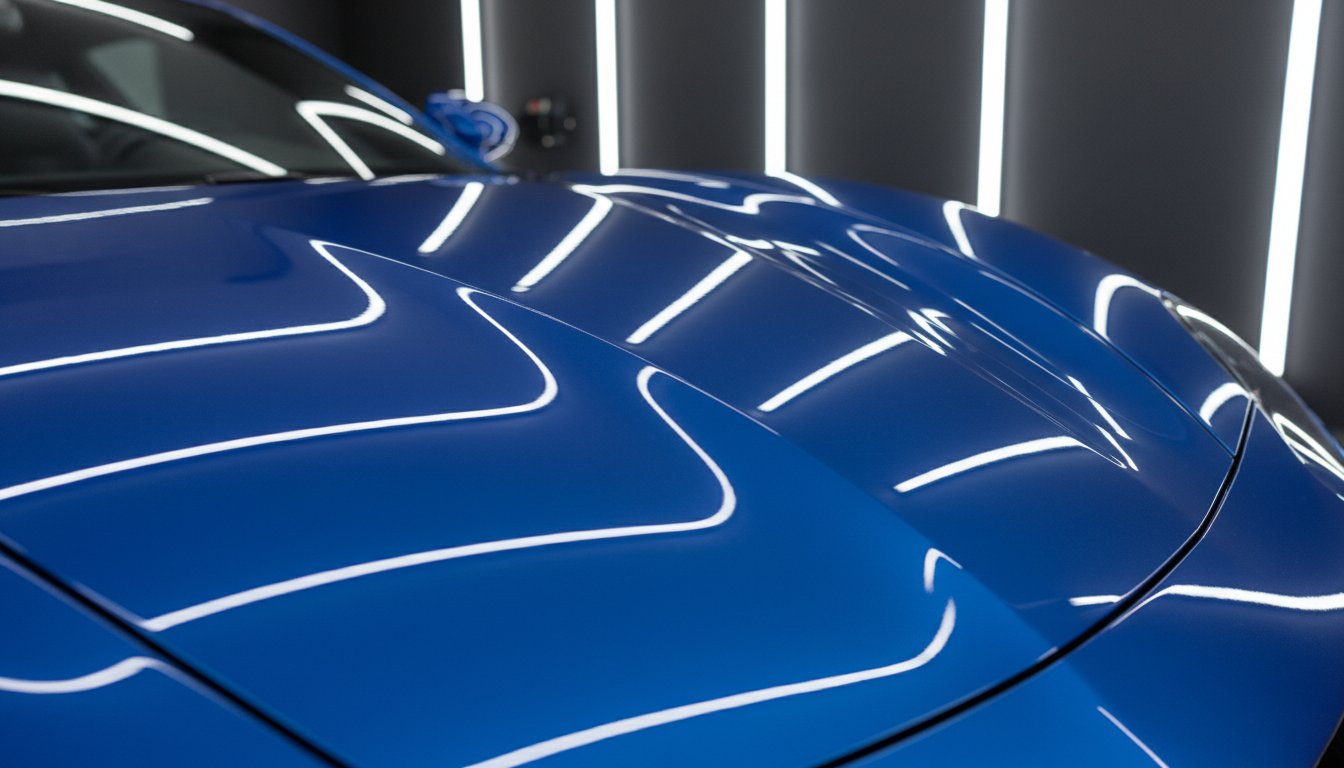
Mastering Deep Gloss Paint Correction: The Specialist’s Guide to Flawless Automotive Finishes
Most car owners believe that a deep shine comes from the wax they apply, but true brilliance is actually found beneath the surface of your clear coat. Achieving a genuine, mirror-like finish requires more than just a superficial cleaning; it demands a precise process of light management. This level of deep gloss paint correction isn't about adding layers. Instead, it's about removing the microscopic imperfections, ridges, and valleys that scatter light and dull your vehicle's appearance.
You've likely felt that sting of frustration when direct sunlight reveals a web of unsightly swirl marks or a hazy film that masks your car's true color. It's natural to worry that aggressive machine polishing might burn through your clear coat, leaving your investment compromised. We understand that your vehicle is a legacy worth preserving, and you deserve the peace of mind that comes from expert-level care. This guide reveals the professional secrets to restoring showroom clarity and achieving a flawless finish that lasts. You'll discover the meticulous steps of paint leveling, the importance of surface decontamination, and how elite specialists transform dull surfaces into masterpieces of reflection.
Key Takeaways
- Discover how mechanical leveling creates a perfectly flat surface to ensure light reflects with absolute precision and clarity.
- Identify the common environmental "gloss killers" and factory imperfections that prevent your paint from reaching its full aesthetic potential.
- Learn why professional deep gloss paint correction is a specialized restorative art that outperforms standard detailing and temporary "all-in-one" products.
- Explore the rigorous multi-step preparation and clean-room standards required to achieve a truly flawless, mirror-like finish.
- Understand why integrating a ceramic coating after restoration is the most effective way to preserve your vehicle's newly revealed depth and value.
The Physics of Perfection: Understanding Deep Gloss Paint Correction
True brilliance isn't found in a bottle of wax or a quick spray sealant. It's engineered through the structural restoration of your vehicle's clear coat. At its core, paint correction is the mechanical leveling of the clear coat to remove surface defects. By carefully thinning the uppermost layer of paint, we create a perfectly flat plane that allows light to interact with the surface as intended. This isn't just about cleaning; it's about precision resurfacing that respects the integrity of your vehicle’s finish.
This commitment to structural integrity and precision is a principle that applies to more than just automotive care. In the same way that experts level a clear coat for optimal results, Precision Spinal Care focuses on the precise alignment of the spine to restore the body’s natural balance and performance.
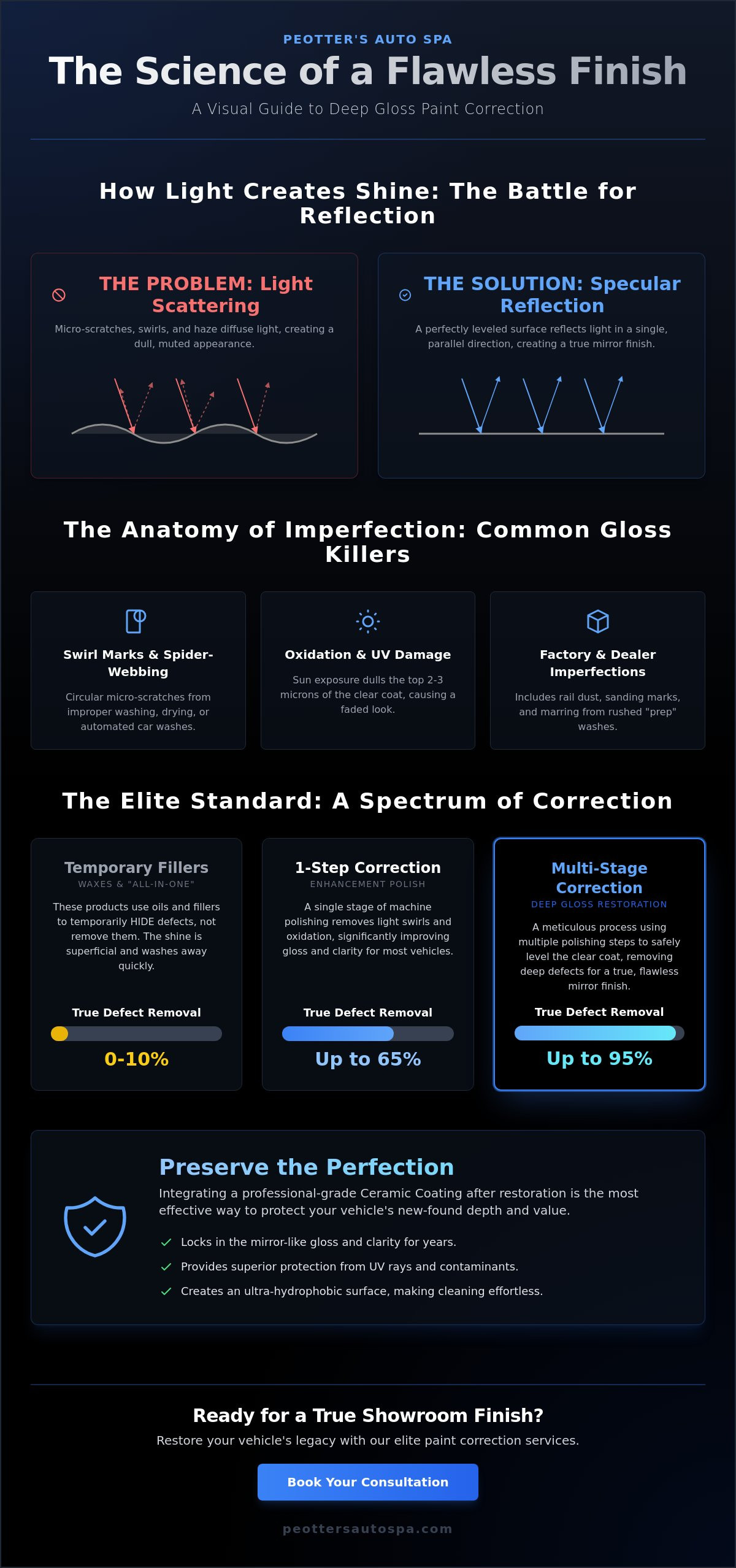
When a surface is perfectly level, it achieves what specialists call the "Mirror Effect." This is technically known as specular reflection. In this state, light rays hit the surface and bounce back in a single, parallel direction. This creates the crisp, sharp reflections seen on showroom-quality vehicles. We often distinguish between two distinct visual qualities:
- Gloss: The measurable reflectivity of the surface. It’s how much light bounces off the clear coat.
- Depth: The clarity of the underlying pigment. It’s the ability to see "into" the paint, revealing the true richness of the color.
A successful deep gloss paint correction achieves both. It removes the microscopic interference that clouds the clear coat, allowing the base color to pop with a level of vibrancy that factory finishes rarely achieve on their own. A master specialist acts as a guardian of your vehicle's value, carefully managing clear coat thickness to ensure the finish is flawless without being over-thinned.
While we focus on automotive surfaces, the principles of expert refinishing apply to many high-value home investments as well. For homeowners looking to restore their kitchen's brilliance, Cabinet refinishing Denver provides professional-grade results that match the standards of elite automotive care.
Light Refraction vs. Light Scattering
Microscopic scratches, swirl marks, and etchings act like tiny prisms on your car's surface. Instead of reflecting light cleanly, these defects cause light scattering. This diffusion of light creates the "haze" or "spider web" effect visible in direct sunlight. On dark-colored vehicles, this scattering is particularly distracting because the high contrast makes every imperfection stand out. While temporary fillers and waxes might "hide" these defects for a few weeks, they don't fix the light path. Only mechanical correction restores the structural clarity needed for a permanent, "wet look" shine.
The Role of the Clear Coat in Automotive Aesthetics
Your vehicle’s clear coat is a finite resource often referred to as the "sacrifice layer." It’s designed to protect the base pigment from environmental hazards, but it can only be leveled so many times. Environmental factors like UV rays and oxidation typically dull the top 2-3 microns of paint over time. According to industry data, a 1-step correction can remove up to 65% of these defects, while a multi-stage process can address up to 95% of imperfections. Our goal is to achieve maximum aesthetic impact while preserving enough thickness for long-term protection and resilience. This balance is what separates elite specialists from high-volume detailers.
The Anatomy of Imperfection: What is Stealing Your Shine?
Daily driving in Springfield subjects your vehicle to a relentless barrage of environmental contaminants that slowly erode its visual appeal. Even if you've just taken delivery of a factory-new vehicle, the paint is rarely in a state of absolute perfection. Vehicles often arrive at the showroom with rail dust, which are microscopic iron particles from transport, embedded deep in the clear coat. Dealers frequently exacerbate this by performing hurried "prep" washes. These high-volume cleaning methods introduce fine marring and surface scratches before the owner ever turns the key for the first time.
Specialists categorize these defects by their depth to determine the safest restoration path. Level 1 defects are superficial marring that sits on the very top of the clear coat. Level 3 defects, however, penetrate much deeper into the finish. These require a multi-stage deep gloss paint correction to safely level the surrounding area without compromising the paint's integrity. Unskilled high-speed buffing often leaves behind "holograms" or "buffer trails." These rhythmic, greasy-looking smears are caused by improper pad choice or excessive heat. They actually decrease clarity by creating a secondary layer of interference that hides the paint's true color.
Swirl Marks and Spider-Webbing
Swirl marks are the most common "gloss killer" encountered by car enthusiasts. These circular micro-scratches usually stem from improper contact during the wash cycle, such as using a dirty wash mitt or visiting an automated brush car wash. These abrasions act as tiny valleys that trap light and prevent it from reflecting cleanly. This diffusion of light obscures the paint’s metallic flake, making a vibrant finish look dull and flat. While light "love marks" are easily addressed, Random Isolated Deep Scratches (RIDS) are deeper and more linear. They require a focused, expert approach to ensure the surface returns to a mirror-like state without unnecessary paint removal.
Chemical Etching and Oxidation
The environmental landscape in New Jersey presents unique challenges for automotive preservation. Bird droppings and acid rain are highly corrosive, eating into the clear coat structure if they aren't neutralized quickly. This chemical etching creates "craters" that are visible even in low light. Over time, consistent UV exposure leads to oxidation. This process makes the clear coat become chalky, porous, and brittle. Instead of reflecting light, the oxidized paint absorbs it, leaving the vehicle looking aged and lifeless. Identifying these specific imperfections is the first step toward a true restoration. If you notice your vehicle's finish looks hazy or textured, a professional evaluation for paint correction can determine the safest path to reclaiming that lost brilliance and protecting your investment.
Professional Correction vs. Detailing: The Elite Standard
Many vehicle owners confuse a standard detail with the specialized art of restoration. While a detail focuses on deep cleaning and temporary protection, the "Auto Spa" philosophy centers on the permanent rejuvenation of the surface. We view ourselves as guardians of your vehicle's factory finish. Our goal isn't just to make a car look better; it's to restore the clear coat to a state of optical perfection that exceeds its original delivery condition. This distinction is vital because maintenance and restoration require entirely different skill sets, environments, and levels of precision.
This "spa" philosophy of meticulous restoration and surface protection is a standard that applies to more than just vehicles. For those who appreciate professional-grade aesthetic refinement, you can explore Manicure hybrydowy (Hybrid manicure) to see how expert techniques ensure a durable and brilliant finish in personal styling as well.
This dedication to professional-grade refinement extends to other beauty industries where precision is key. For hair stylists looking to provide their clients with a perfectly smooth and radiant finish, they can discover Hair Bar NYC Professional and its range of salon-exclusive hair care and smoothing systems.
"All-in-one" (AIO) products often found in consumer detailing kits are insufficient for achieving a true mirror-like result. These products typically use chemical fillers to hide the swirl marks and light scattering we discussed previously. Once the fillers wash away, the original defects return. A professional deep gloss paint correction removes these imperfections permanently through mechanical leveling. In a DIY setting, the risk of "burning" the paint is significant. Improper heat management or using the wrong pad-and-polish combination can lead to strike-through, where the clear coat is completely removed. Our specialist approach mitigates this risk through constant monitoring and technical mastery.
The Multi-Stage Approach
Every vehicle requires a bespoke strategy based on its current condition and the owner's goals. We typically categorize our restoration paths into three distinct tiers:
- One-Step Enhancement: Ideal for well-maintained vehicles, this process removes light marring and can eliminate up to 65% of surface defects while significantly boosting gloss.
- Two-Step Correction: Often considered the "Gold Standard," this involves a heavy cutting stage followed by a finishing polish. It typically addresses 85-95% of imperfections, including deeper swirl marks and light etching.
- Three-Step / Concours Correction: This is a pursuit of absolute perfection, often reaching 99% defect removal. It's a methodical, multi-day process reserved for show cars and elite collections where every square inch must be flawless.
Specialized Tooling of the Master Craftsman
A master specialist relies on data rather than guesswork. We utilize Paint Thickness Gauges (PTG) to measure the remaining clear coat before any machine touches the paint. This ensures we have a safe margin for deep gloss paint correction without compromising the vehicle's long-term resilience. We also employ a mix of Dual-Action (DA) and Rotary polishers. While a Rotary polisher offers incredible cutting power for heavy defects, the DA polisher provides the safety and refined finishing needed for a haze-free shine. Finally, we work under high-CRI (Color Rendering Index) lighting. These specialized lamps mimic natural sunlight, revealing every hidden defect that standard shop lights might miss. You simply can't correct what you can't see.
Precision is equally important when marking defects or adding custom details to a vehicle's exterior. For hobbyists and professionals who require high-quality paint markers for these tasks, PoscART offers a premium selection of authentic tools and accessories to ensure every detail is handled with care.
The Multi-Step Restoration Process: A Journey to Flawless
Elite results are born in a controlled, clean-room environment. We operate in a specialized workspace designed to minimize airborne contaminants that could interfere with the polishing pads or mar the surface during the restoration. This level of meticulousness ensures every pass of the machine is productive, safe, and precise. Achieving a world-class finish isn't a race. It's a methodical journey that respects the delicate nature of your vehicle's clear coat.
Before any machine touches the paint, we must ensure the surface is surgically clean. This preparation phase is the most critical part of the deep gloss paint correction process. Any lingering grit or iron particles could be picked up by the polishing pad, causing severe damage rather than restoration. We follow a strict protocol to strip the vehicle down to its true, naked finish, allowing us to see every defect clearly before we begin the refinement cycle.
Decontamination: The Foundation of Gloss
We start with chemical decontamination to dissolve iron particles and industrial fallout that standard washing cannot reach. This is followed by mechanical decontamination via the clay bar process, which lifts bonded surface grit to create a smooth-as-glass foundation. Finally, we strip away old waxes and silicones. This reveals the true state of the paint, ensuring our abrasives work directly on the clear coat rather than sliding over old, temporary products. This tripartite preparation ensures the highest level of clarity from the very first pass.
The Correction Cycle: Cut, Level, and Polish
The actual restoration follows a rhythmic refinement cycle that moves from heavy leveling to jewel-like polishing. We begin with compounding, an aggressive phase designed to level deep scratches and significant surface defects. Once the surface is leveled, we move into the polishing stage to remove compounding haze and restore optical clarity. The final step is jeweling. This ultra-fine stage uses specialized pads and finishing liquids to create that coveted "wet look" depth. Research indicates that a multi-stage process can address up to 95% of imperfections, and our jeweling stage is the key to reaching that final tier of excellence.
Precision during this refinement is paramount; many specialists rely on the high-quality marking and detailing tools available through PoscART to ensure every square inch of the surface meets their exacting standards.
Post-Correction Inspection
We never assume perfection; we verify it through rigorous testing. We perform a final wipe using Isopropyl Alcohol (IPA) to ensure no polishing oils are hiding remaining defects. Our specialists then use high-CRI sun-guns to inspect the finish under multiple light spectrums. This verifies the total removal of holograms and confirms a truly flawless result. We conclude with a "towel test" to confirm perfect surface tension and smoothness across every panel. If your vehicle’s finish has lost its luster, you can trust our experts to perform a world-class paint correction that restores its original glory and preserves its value.
Preserving the Perfection: Beyond the Correction
Once the meticulous process of mechanical leveling is complete, your vehicle’s finish is at its optical peak. However, this newly revealed surface is also at its most vulnerable. Without the protection of waxes, sealants, or advanced coatings, the naked clear coat is directly exposed to environmental hazards. A successful deep gloss paint correction removes the defects that once shielded the paint from further wear, making immediate preservation a technical necessity rather than an optional luxury. We view the restoration as the foundation upon which long-term resilience is built.
To ensure your vehicle maintains its mirror-like clarity, we recommend transitioning from restoration to fortification. While traditional waxes offer a temporary glow, they lack the structural integrity needed to preserve a professional correction. Modern automotive care has evolved, offering solutions that bond at a molecular level to keep your car looking as though it just left our studio. By choosing the right protective layer, you ensure that the hours of precision labor invested in your vehicle’s finish aren't undone by the first drive or wash cycle. Similarly, homeowners looking to protect and enhance their interior surfaces can discover Cabinet Painting Denver for high-quality kitchen cabinet refinishing.
Ceramic Coating: Locking in the Shine
A professional ceramic coating is the logical partner for any corrected surface. This liquid polymer creates a semi-permanent bond that adds a layer of 9H hardness over your clear coat. This crystalline shield provides three essential benefits: superior UV protection to prevent oxidation, extreme chemical resistance against bird droppings, and a hydrophobic surface that makes future maintenance effortless. When water and contaminants bead off the surface, the risk of introducing new swirl marks during washing is significantly reduced. It effectively locks in the results of your deep gloss paint correction for years to come.
For owners of performance vehicles or those who frequent the highway, paint protection film (PPF) offers the ultimate defense. While coatings protect against chemistry and light, PPF defends against physics. This high-impact, self-healing film is applied to vulnerable areas like the hood, bumper, and mirrors to stop rock chips and road debris from reaching the paint. Integrating PPF with a ceramic coating provides a comprehensive "white-glove" protection suite that preserves both the aesthetic and the resale value of your investment. For enthusiasts looking to add custom artistic details to their protected finish, you can learn more about PoscART and their selection of premium detailing markers available online.
The Springfield Professional Advantage
The local climate in New Jersey presents specific challenges that make professional preservation essential. From the corrosive road salt used in winter to the high humidity of summer, Springfield vehicles face a constant battle against dullness and decay. Our commitment to excellence means we don't just clean; we rejuvenate and protect. We invite you to experience the difference that meticulous attention to detail and master craftsmanship can make for your vehicle. Our specialists are ready to act as the guardians of your car’s legacy, ensuring every curve and contour reflects perfection. To begin your journey toward a flawless finish, schedule your paint consultation at Peotter's Auto Spa and discover what true automotive excellence feels like.
Elevate Your Automotive Investment to a New Standard of Excellence
True beauty is more than a superficial shine; it's the result of meticulous light management and structural restoration. By understanding the physics of reflection and the critical role of your vehicle's clear coat, you move beyond basic maintenance toward genuine preservation. A professional deep gloss paint correction doesn't just hide defects. It permanently removes them to reveal a level of clarity and vibrancy that factory finishes rarely achieve on their own.
At Peotter's Auto Spa, we bring a 1994 heritage of automotive excellence to every project we undertake. As a family-owned boutique service in Springfield, NJ, we utilize specialized high-CRI lighting to detect and eliminate even the most elusive imperfections. We treat your vehicle as a significant investment, providing the meticulous attention and white-glove care it deserves. You've invested in a legacy. We're here to ensure it shines with a mirror-like brilliance that reflects your pride of ownership.
The pride of ownership and desire to preserve a legacy isn't limited to the automotive world. For those who want to commemorate their own athletic milestones with the same level of care, you can explore Premium Trading Cards and other custom memorabilia from Custom Sports Products.
Experience the Flawless Finish Your Vehicle Deserves at Peotter's Auto Spa
Your car's best days aren't behind it. Much like the expert transformation offered by Cabinet refinishing Denver for high-value home interiors, we look forward to revealing your vehicle's true potential and helping you take pride in every mile.
Frequently Asked Questions
How long does a professional deep gloss paint correction take?
A professional restoration typically requires anywhere from twelve hours to several days of dedicated labor. A single-stage enhancement might be completed in a full workday, but a multi-stage deep gloss paint correction often demands thirty to forty hours of meticulous refinement. The exact timeframe depends on the vehicle's size, the hardness of the clear coat, and the severity of the existing surface defects.
Will paint correction remove all the scratches on my car?
This process successfully removes imperfections that reside within the clear coat, such as swirl marks, light marring, and chemical etching. If a scratch has penetrated through the clear coat into the base color or primer, it cannot be fully removed through leveling. In those instances, we focus on rounding the edges of the scratch to minimize its visibility while preserving the structural integrity of the surrounding paint. For enthusiasts and professionals who need to precisely mark these deep defects during the inspection phase, PoscART provides the high-quality marking tools required for meticulous surface preparation.
How often should I have my vehicle's paint corrected?
You should ideally only perform a major correction once or twice during a vehicle's entire lifespan. Because the process involves removing a microscopic layer of the clear coat, frequent aggressive leveling can eventually lead to paint failure. We recommend following a deep gloss paint correction with a professional protective layer to ensure you only need light maintenance polishing in the future.
Is paint correction safe for new cars with thin clear coats?
Restoration is entirely safe and often necessary for new vehicles when performed by a specialist using a paint thickness gauge. Many factory-fresh cars arrive at the dealership with "rail dust" or marring from improper transit washing. We use non-destructive testing to measure the clear coat depth, ensuring we achieve a flawless finish while leaving the maximum amount of protection intact.
What is the difference between a 'buff and wax' and a paint correction?
A "buff and wax" is a temporary maintenance service that uses chemical fillers to hide scratches, while a correction is a permanent mechanical restoration. Buffing often creates "holograms" if handled by an unskilled operator, but a true correction levels the surface to allow light to reflect perfectly. This structural change results in a level of optical clarity and depth that temporary waxes simply cannot match. This focus on permanent, structural improvement is a philosophy shared by Precision Spinal Care, where a NUCCA chiropractor Chelsea MI focuses on precise spinal alignment to achieve lasting results.
Can I perform a deep gloss paint correction myself at home?
While DIY enthusiasts can attempt the process, the risk of "burning" through the clear coat or creating buffer trails is high without professional training. Achieving elite results requires a significant investment in high-CRI lighting, specialized polishers, and paint thickness gauges. Most owners find that trusting a dedicated specialist is the best way to protect their investment and ensure a perfect, haze-free result.
Does paint correction increase the resale value of my vehicle?
A flawless exterior significantly boosts a vehicle's market appeal and perceived value. A car that exhibits a mirror-like finish suggests a history of meticulous care and high-end maintenance to potential buyers. This comprehensive approach to care should also include essential safety components; for example, sourcing quality tires from a trusted specialist like Partner Tires ensures your car performs as well as it looks. By restoring the paint to its showroom condition, you differentiate your vehicle from others on the market and can often justify a higher asking price for your investment.
Should I get a ceramic coating immediately after paint correction?
Applying a ceramic coating immediately following restoration is the most effective way to preserve your results. The correction process leaves the clear coat "naked" and perfectly prepared for a protective bond. Adding a coating at this stage locks in the newly revealed depth and provides a 9H hardness layer that shields the finish from UV rays and environmental contaminants for years.