Self-Healing PPF: The Science of Meticulous Surface Protection
Your vehicle's factory paint is a vulnerable investment that begins to degrade the moment you merge onto a New Jersey highway, but self healing ppf offers a revolutionary way to fight back. You've likely felt that familiar sting of anxiety when a stray pebble kicks up from the road or noticed the faint, spider-web swirl marks that appear after a standard wash. It's frustrating to invest in a high-end vehicle only to watch its pristine finish slowly succumb to the elements, leaving you to worry about diminishing resale value and lost aesthetic perfection.
We believe that your car should remain as flawless as the day it left the showroom. In this article, you'll discover the advanced polymer science behind modern protection films and how they act as a meticulous, regenerative skin for your vehicle. We'll explore how these sophisticated systems use heat-activated memory to erase surface defects, providing you with total peace of mind during every drive. From the technical mechanics of elastomeric polymers to the long-term benefits of a professional installation, you'll gain a clear understanding of how to maintain a permanent, first-class gloss for years to come.
Key Takeaways
- Learn how advanced TPU polymers utilize a unique memory effect to automatically erase surface defects when exposed to heat.
- Understand the specific types of damage that self healing ppf can resolve, including wash-induced swirl marks and environmental etchings.
- Discover how premium films provide a critical chemical barrier against the harsh winter road brine and magnesium chloride found on New Jersey highways.
- Explore why a flawless finish requires meticulous paint correction and professional application to ensure long-term durability and optical clarity.
- Recognize the evolution of automotive protection from outdated yellowing films to modern systems that act as an invisible, regenerative skin.
Understanding Self-Healing Paint Protection Film (PPF)
Protecting a high-end vehicle requires more than just a routine wax or a high-quality ceramic coating. Modern Paint Protection Film (PPF) is an advanced, multi-layered thermoplastic urethane skin designed to absorb the brunt of road hazards. Unlike the thick, yellowing clear bras of previous decades, today's self healing ppf offers incredible optical clarity that enhances rather than obscures your vehicle's natural finish. It serves as a sacrificial barrier, standing between your factory paint and the harsh realities of the open road. The true innovation behind this technology lies in its surface memory, which allows the film to dissipate the energy of a physical impact and then restructure itself at a molecular level.
The Evolution of Automotive Surface Preservation
The origins of this technology are found in the aerospace industry, where it was originally developed to protect helicopter rotor blades from abrasive sand and debris. Over decades, this rugged material was meticulously refined into the elite automotive protection we utilize today. It's vital to distinguish between standard vinyl wraps and protective urethane films. Vinyl is primarily an aesthetic tool; it's thin, prone to tearing, and offers almost no impact resistance. In contrast, self healing ppf is a high-density elastomeric polymer specifically engineered for impact protection. Modern luxury vehicles often feature water-based factory clear coats that are thinner and softer than ever before. This makes a secondary, protective skin a critical requirement for anyone looking to maintain a showroom-quality finish in a high-traffic environment.
Why 'Self-Healing' is the Gold Standard for Enthusiasts
For the discerning enthusiast, the value of self-healing technology is as much psychological as it is physical. There is an immense sense of relief that comes with driving a protected vehicle through the unpredictable conditions of the Northeast. You no longer need to wince every time you hear a pebble strike the front bumper or worry about light surface contact in a crowded parking lot. Because the film is engineered to maintain its own integrity, your car retains a "just-detailed" look long after it leaves our studio. This level of preservation directly supports the vehicle's long-term paint integrity. A vehicle with flawless factory paint, shielded by a high-quality film, consistently commands a premium in the pre-owned market. It serves as a silent testament to an owner's commitment to excellence and meticulous care, ensuring that the investment is protected from both the elements and the passage of time.
The Science of 'Memory': How TPU Polymers Fix Themselves
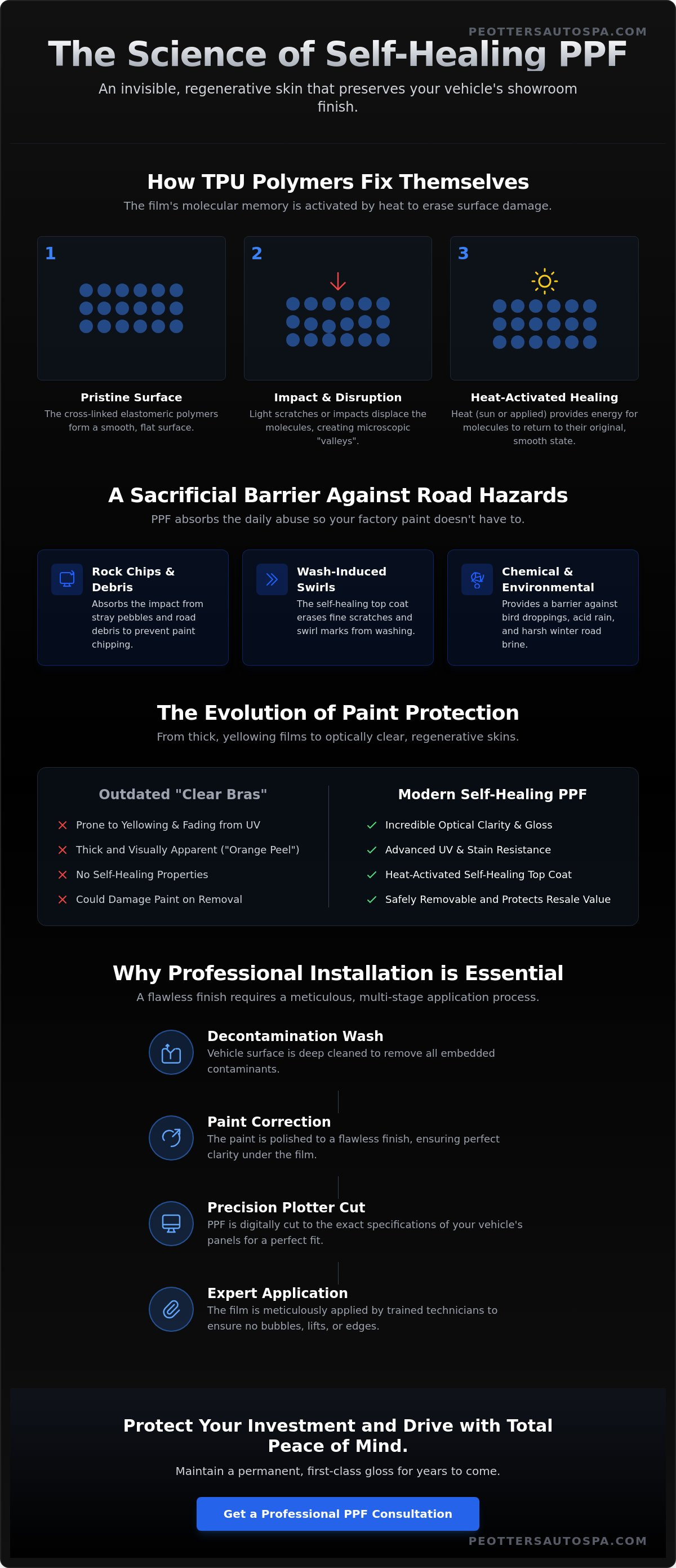
The brilliance of self healing ppf isn't found in a magic trick. It's found in the sophisticated architecture of Thermoplastic Polyurethane (TPU). This high-density elastomeric polymer functions as a "living" shield for your vehicle. Unlike traditional automotive finishes that are static and brittle, TPU is engineered with a molecular memory. When a stone or a coarse wash mitt strikes the film, it doesn't actually remove material. Instead, it displaces the molecules, creating microscopic "valleys" in the surface. Because the polymer is cross-linked and calibrated to a specific flat state, those molecules are constantly straining to return to their original positions.
This regenerative capability is deeply rooted in chemical engineering. Leading research on self-healing polyurethane highlights how these materials utilize reversible hydrogen bonding. When the film sustains a light scratch, the bonds are temporarily stretched. To snap them back into place, the film requires a specific amount of activation energy. Once this energy threshold is met, the "valleys" close as the molecules reorganize into their factory-calibrated alignment. The result is a surface that appears to heal itself before your eyes, maintaining a level of perfection that was once thought impossible for a driven vehicle.
The Role of Heat in the Activation Process
Heat is the essential catalyst that triggers this molecular reorganization. In many cases, the ambient warmth from a sunny New Jersey afternoon provides more than enough energy to erase daily swirl marks. For deeper scuffs, our specialists use controlled heat sources like warm water or precision heat guns to accelerate the transition. It's a delicate balance. The film doesn't melt or lose its structural integrity. It simply becomes more fluid at a microscopic level, allowing the internal memory to pull the surface back to a flawless, level plane.
Elastomeric Properties vs. Rigid Coatings
Many owners ask why a ceramic coating can't fix itself. The answer lies in the material's rigidity. Ceramic coatings create a hard, glass-like structure that is exceptional for shedding water and resisting chemicals, but they are brittle. When a coating is scratched, the structure is fractured. TPU is different. Its elastomeric properties allow it to stretch and compress, absorbing the energy of an impact that would otherwise chip your paint. By pairing this flexible base with a high-gloss top coat, we provide a solution that offers both the resilience of a shield and the brilliance of a show car. If you're ready to experience this level of protection, our team can help you select a self healing ppf package that best suits your driving habits.
Capabilities and Limitations: What Can Actually 'Heal'?
While the molecular memory of TPU is impressive, it's not an invincible force field. The regenerative properties of self healing ppf are primarily contained within the film's advanced top coat. This thin, clear layer is engineered to be soft enough to reorganize but resilient enough to protect the high-density urethane core beneath it. Understanding the distinction between a surface defect and a structural puncture is key to managing your expectations for this technology. The film is a sophisticated defense system, but it operates within the laws of physics and material science.
Most common aesthetic frustrations are easily resolved by the film's memory. These include wash-induced swirl marks, light scuffs from brushing against the vehicle, and chemical etchings from bird droppings or acidic rain. Recent academic developments in bio-based thermoplastic polyurethane demonstrate that the efficiency of this healing depends on the stability of the hydrogen bonds within the polymer matrix. When these bonds are merely stretched by a light impact, they can return to their original state. However, if the impact is severe enough to sever the polymer chains entirely, the damage becomes permanent.
Everyday Hazards the Film Easily Absorbs
Commuting on the Garden State Parkway or navigating local New Jersey routes exposes your vehicle to a constant barrage of micro-impacts. Small pebbles, road salt, and industrial fallout are part of daily life here. A high-quality film absorbs these hits, preventing the tiny chips that eventually lead to rust or a dull finish. By neutralizing these hazards, the film effectively eliminates the need for aggressive paint correction every season. This preservation keeps your factory clear coat's thickness and integrity intact, ensuring the paint remains as deep and vibrant as the day it was sprayed.
When the Damage Goes Beyond the Surface
There is a clear "point of no return" for any protective film. If a sharp object or a high-velocity stone penetrates through the top coat and deep into the urethane core, the film won't heal. In these instances, you'll see a visible tear or a "scar" in the material. While this might seem like a failure, it is actually a definitive success. The film has performed its primary duty as a sacrificial barrier. It took the damage so your factory paint didn't have to. Replacing a single film panel on a fender or hood is a precise, straightforward process that is far more cost-effective than a professional repaint. Most importantly, it keeps your vehicle's original finish intact, which is the single most important factor for maintaining maximum resale value.
PPF in the Northeast: Protecting NJ Vehicles Year-Round
Driving in Springfield or navigating the heavy traffic of Union County presents a relentless challenge to your vehicle's exterior. Our local environment is particularly unforgiving, combining high-speed highway travel with aggressive seasonal weather patterns. For the dedicated enthusiast, a standard wax or sealant isn't enough to combat the abrasive nature of New Jersey roads. This is where the installation of self healing ppf becomes a strategic necessity rather than a luxury. It provides a robust, chemically resistant barrier that shields your investment from the specific environmental stressors found right here in the Northeast.
During the colder months, the threat shifts from standard road debris to a corrosive mixture of magnesium chloride and liquid brine. These de-icing agents are engineered to stick to surfaces, meaning they linger on your paint long after the storm has passed. Without protection, these chemicals can penetrate the clear coat, leading to oxidation and permanent staining. A premium film installation acts as a non-porous shield, preventing these caustic substances from ever making contact with your factory finish. It also neutralizes the "sandblasting" effect caused by the winter gravel and salt that permeate every local route, ensuring your leading edges remain crisp and unblemished.
Battling Road Salt, Brine, and Winter Debris
Winter is undeniably the most hazardous season for a vehicle's finish in New Jersey. The combination of freezing temperatures and sharp, salt-laden slush creates a perfect storm for surface degradation. We recommend a regular maintenance schedule to keep your film performing at its peak. When cleaning salt crust from your vehicle, always use a lubricated, two-bucket wash method. The self-healing properties of the film mean that any micro-scratches created during the removal of heavy winter debris will simply vanish once the surface warms, maintaining that flawless showroom appearance through the harshest months of the year.
UV Resistance and Preventing Film Yellowing
As the seasons shift, the challenge moves from chemical corrosion to intense UV exposure. The high-UV summer months in the Northeast can cause inferior films to become brittle and discolored. At Peotter's Auto Spa, we exclusively utilize elite films infused with advanced UV stabilizers. These stabilizers prevent the polymer chains from breaking down, effectively debunking the myth that protective films must eventually turn yellow. This protection extends to your paint as well, blocking the rays that cause vibrant colors to fade and oxidize. If you want to ensure your vehicle remains pristine in every season, request a quote for self healing ppf today to secure the ultimate level of preservation.
The Meticulous Application: Why Professional Installation is Essential
Achieving a flawless result with self healing ppf requires far more than just a squeegee and a bottle of soapy water. At Peotter’s Auto Spa, we treat every installation as an act of precision craftsmanship. While the internet is full of DIY myths suggesting that film application is a simple weekend project, the reality is that the environment and the preparation determine the longevity of the shield. A professional installation is a "white-glove" experience where every variable, from air quality to surface temperature, is strictly controlled to ensure an invisible, durable finish.
The most critical step in our process happens before the film ever touches the vehicle. A comprehensive paint correction is a non-negotiable prerequisite for our standards. Installing a high-clarity film over swirl marks, light scratches, or factory defects effectively seals those imperfections in place for years. By leveling the clear coat and restoring a deep, mirror-like shine first, we ensure that the film enhances the paint rather than highlighting its flaws. Our climate-controlled installation bay acts as a sanctuary, eliminating the dust and airborne contaminants that cause bubbles and silvering in budget applications.
Surface Preparation: The Invisible Foundation
A truly resilient bond begins with a multi-stage decontamination wash designed to strip away old waxes and road oils. We follow this with a clay bar treatment to pull embedded metallic particles and environmental fallout from the pores of the paint. This level of cleanliness is vital for the adhesive to function as intended. We pay special attention to every edge, corner, and body line, ensuring they're surgically clean. This meticulousness prevents the film from lifting at the edges, a common failure point in lower-quality installations that haven't been properly prepped.
Precision Edges and the Peotter's Standard
There is a vast difference between a standard pre-cut kit and a custom-tailored installation. Many shops use templates that leave a visible gap around badges, sensors, and panel edges. We prefer the art of "wrapped edges," where the film is tucked behind the panels for a truly seamless and undetectable finish. This technique requires an expert-level skill set and a deep understanding of the film's tension and stretch limits. It's this commitment to perfection that allows us to provide a level of security and aesthetic excellence that DIY attempts simply can't match. We invite you to experience the ultimate in automotive preservation by exploring our total vehicle protection packages, where self healing ppf and elite coatings work in harmony to guard your investment.
Elevate Your Vehicle's Resilience and Radiance
Maintaining a showroom finish in the Northeast requires more than just careful driving; it demands a sophisticated, regenerative shield. We've explored how the molecular memory of self healing ppf provides a permanent solution to the swirl marks and environmental etchings that plague unprotected vehicles. By combining advanced polymer science with a meticulous master craftsman approach, you can ensure your car remains a pristine asset rather than a deteriorating one.
At Peotter's Auto Spa, our team of elite specialists understands that true surface preservation begins with flawless preparation and ends with an undetectable finish. Whether you're navigating the Garden State Parkway or storing a weekend prize, the peace of mind that comes from professional-grade protection is incomparable. Don't leave your paint's integrity to chance.
Secure Your Vehicle's Future with Premium PPF at Peotter's Auto Spa and experience the confidence of a permanent, first-class gloss. We look forward to helping you preserve the excellence of your investment for years to come.
Frequently Asked Questions
Does self-healing PPF really fix every scratch on its own?
Self-healing PPF is designed to repair microscopic surface defects rather than deep structural damage. It easily resolves wash-induced swirl marks and light abrasions that haven't penetrated the top layer. If a sharp object cuts through the urethane core, the molecular memory cannot bridge that gap. In those cases, the film has fulfilled its sacrificial duty by protecting the paint, but the film itself will require professional replacement to restore perfection.
How long does the self-healing property of the film actually last?
The regenerative capabilities of premium films typically last for the entire duration of the product's lifespan. Most top-tier manufacturers offer warranties ranging from 10 to 12 years. As long as the film is maintained properly and hasn't been compromised by harsh chemicals, the elastomeric polymers will continue to reorganize when heat is applied. This ensures your vehicle maintains its pristine, just-detailed appearance for a decade or more.
Can I wash my car normally if it has self-healing PPF installed?
You can certainly wash your vehicle normally, though we recommend waiting at least 48 to 72 hours after installation to allow the adhesive to cure fully. Hand washing with the two-bucket method is the ideal way to preserve the film's clarity. While the film is incredibly durable, avoid pointing high-pressure sprayers directly at the edges of the film, as this can lead to premature lifting or moisture intrusion.
Will the sun's heat in New Jersey be enough to trigger the healing process?
The New Jersey summer sun is more than sufficient to trigger the molecular reorganization of self healing ppf. During the warmer months, you'll often see light swirl marks vanish shortly after parking in a sunny lot. In the winter, the ambient temperature may be too low for the "memory" effect to activate on its own. In these instances, pouring warm water over the affected area will provide the necessary energy for the film to heal.
Is self-healing PPF better than a ceramic coating for stone chip protection?
Yes, self-healing PPF is significantly more effective than a ceramic coating for preventing physical impact damage. A ceramic coating is a thin, rigid layer that excels at shedding water and resisting chemical stains, but it lacks the thickness to stop stone chips. PPF is a high-density urethane skin that absorbs and dissipates the energy of an impact. For the ultimate level of protection, many enthusiasts choose to apply a ceramic coating over their film.
Does self-healing PPF turn yellow or peel over time?
Elite films used by meticulous specialists don't turn yellow or peel like the "clear bras" of the past. Modern products are engineered with advanced UV stabilizers that prevent the polymer chains from breaking down under intense sunlight. Peeling is almost always a result of poor installation or improper edge preparation. By choosing a professional, climate-controlled application, you ensure the film remains crystal clear and securely bonded to every contour of your vehicle.
What happens if a scratch is too deep for the film to heal itself?
If a scratch is too deep for the film to heal, it means the object has severed the polymer chains in the urethane core. While the film will no longer return to a flat state, it has almost certainly prevented that damage from reaching your factory paint. We can simply remove the damaged panel and install a fresh piece of film. This is a far more efficient and cost-effective solution than undergoing a professional repaint and losing your original finish.
Can I apply wax or other coatings on top of self-healing PPF?
You can apply ceramic coatings on top of your film to enhance its hydrophobic properties and gloss. In fact, ceramic-infused self healing ppf is a growing trend for those seeking the best of both worlds. However, you should avoid using traditional waxes that contain petroleum distillates or abrasive polishers. These can degrade the film's top coat or get trapped along the edges, potentially compromising the optical clarity you've worked so hard to preserve.