The Science of UV Protection Window Film: Preserving Your Health and Assets in 2026
Every mile you drive, ultraviolet radiation is quietly working against you. It's fading the supple leather on your seats, degrading the dashboard of a vehicle you've invested thousands in, and delivering a cumulative dose of solar radiation directly to your skin through glass that offers far less protection than most drivers realize. Quality UV protection window film isn't a cosmetic upgrade; it's a precision shield engineered to stop up to 99% of that invisible damage before it ever reaches your interior or your skin.
If you've hesitated because of past experiences with cheap DIY films that turned purple, bubbled at the edges, or sacrificed your visibility for a murky tint, that frustration is completely valid. The difference between a bargain film and a professional-grade installation isn't just cosmetic; it's the difference between a product that degrades in two seasons and one that preserves your vehicle's interior and your commercial property's value for years to come.
In this guide, we'll walk you through the science behind UV rejection technology, what separates professional installation from off-the-shelf alternatives, and how the right film delivers cooler interiors, healthier commutes, and lasting protection for both your vehicle and your commercial space.
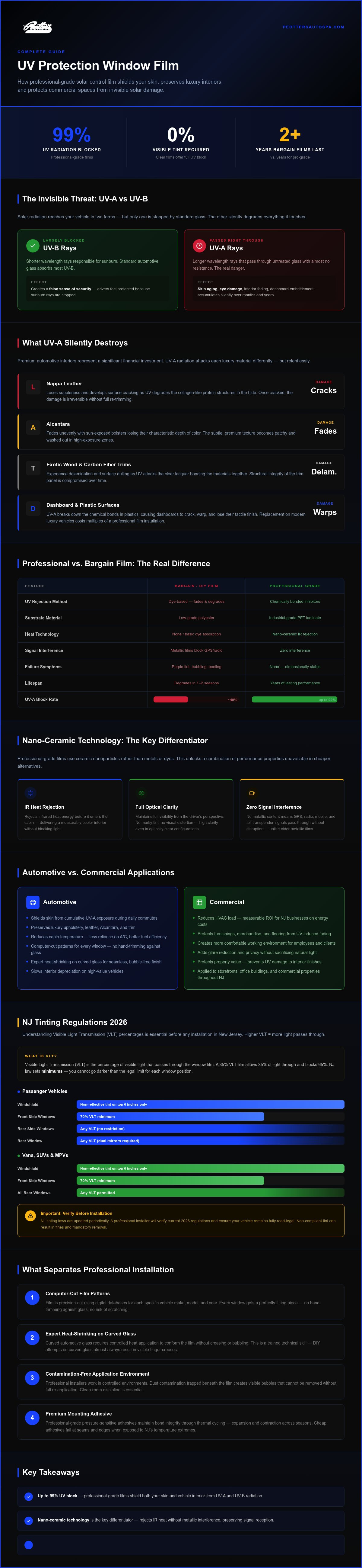
Key Takeaways
- Professional-grade UV protection window film blocks up to 99% of harmful solar radiation, shielding both your skin and your vehicle's interior from the cumulative damage of UV-A and UV-B rays.
- Nano-ceramic technology is the key differentiator in premium films, rejecting infrared heat without metallic interference — delivering a cooler cabin without compromising visibility or signal reception.
- New Jersey's 2026 tinting regulations define specific Visible Light Transmission (VLT) percentages for passenger and commercial vehicles, and understanding these rules is essential before any installation.
- Commercial window film offers NJ businesses a measurable return on investment by reducing HVAC load, protecting furnishings, and creating a more comfortable environment for employees and clients alike.
- The precision of professional installation — from computer-cut film patterns to expert heat-shrinking on curved automotive glass — is what separates a lasting result from a film that fails within seasons.
What is UV Protection Window Film and Why is it Necessary?
At its core, UV protection window film is a precision-engineered, multi-layered polyester laminate applied directly to the interior surface of glass. Each layer serves a distinct purpose: absorbing solar radiation, reflecting infrared heat, and maintaining optical clarity. The result is a barrier that intercepts harmful solar energy before it can penetrate your cabin or commercial space. What surprises most people is that this protection doesn't require any visible tint at all. Optically clear UV films deliver near-total radiation blocking while leaving your windows looking completely untouched.
That distinction matters enormously. Many drivers assume that because their windows look clear, they're unprotected. Others believe that any tint automatically provides UV shielding. Neither assumption is accurate, and that gap in understanding is exactly where cumulative damage takes hold.
The Invisible Threat: UV-A vs. UV-B Rays
Solar radiation reaches your vehicle in two primary forms, and they behave very differently against glass. UV-B rays, the ones responsible for sunburn, are largely absorbed by standard automotive glass. This creates a false sense of security, because the rays you can feel are mostly stopped. UV-A rays, however, operate on a longer wavelength that passes through untreated glass with almost no resistance. These are the silent architects of long-term skin aging, eye damage, and interior degradation. In 2026 luxury vehicles, UV-A radiation is the primary cause of interior fading, color shift in premium upholstery, and the gradual embrittlement of dashboard surfaces.
The cumulative nature of this exposure is what makes it so insidious. A single drive doesn't register. But across months and years of daily commutes, the dose accumulates on your skin and on every surface inside your vehicle.
Preservation of High-Value Assets
Premium automotive interiors represent a significant financial investment, and solar radiation treats them indiscriminately. UV-A exposure breaks down the chemical bonds in plastics, causing dashboards to crack, warp, and lose their tactile finish. The impact on luxury materials is even more pronounced:
- Nappa leather loses its suppleness and develops surface cracking as UV degrades the collagen-like protein structures in the hide.
- Alcantara fades unevenly, with sun-exposed bolsters losing their characteristic depth of color.
- Exotic wood and carbon fiber trims experience delamination and surface dulling as UV attacks the clear lacquer bonding them together.
Replacing a cracked dashboard on a modern luxury vehicle or re-dyeing sun-faded Alcantara costs multiples of what a professional UV protection window film installation requires. The film doesn't just protect your comfort; it protects a depreciating asset from depreciating faster than it should.
The Science of Professional Solar Control Films
Understanding why premium UV protection window film outperforms bargain alternatives requires a look at what's actually happening at the molecular level. Professional-grade films aren't simply darker or thicker versions of what you'll find rolled up in a retail display. They're precision-engineered laminates where every layer serves a specific, measurable function.
The foundation of any professional film is a high-clarity PET (polyethylene terephthalate) substrate. Industrial-grade PET is dimensionally stable, resistant to chemical degradation, and engineered to maintain its optical properties across years of thermal cycling. Cheap DIY alternatives use lower-grade polyester that's vulnerable to UV-induced polymer breakdown, which is exactly what causes that telltale purple discoloration and edge bubbling. The dye molecules in bargain films absorb UV energy, but rather than dissipating it safely, they degrade under prolonged exposure and release it as visible color shift. Professional films don't rely on dyes for UV rejection at all. UV inhibitors are chemically bonded into the adhesive and substrate layers, making them structurally integral rather than a surface treatment that fades over time.
The mounting adhesive layer is equally important and frequently overlooked. Premium pressure-sensitive adhesives are formulated for optical clarity and long-term adhesion without outgassing, which is the process that creates bubbles between film and glass as inferior adhesives break down in heat. A scratch-resistant hard coat on the exposed face completes the construction, protecting the film from the micro-abrasions of daily cleaning that would otherwise dull a lesser product within months.
Ceramic vs. Traditional Dyed Films
Nano-ceramic technology represents the most significant advancement in solar control film in recent decades. Ceramic particles, suspended at the nano scale within the film matrix, physically block and scatter infrared radiation without absorbing it in a way that causes the film to degrade. The practical result is substantial heat rejection without any metallic content, which is a critical distinction for modern vehicles. Metalized films, while effective at heat rejection, create a Faraday-cage effect that interferes with GPS accuracy, cellular signals, and the 5G connectivity that 2026 vehicles increasingly depend on for navigation, over-the-air updates, and telematics. Ceramic films reject heat and leave every signal pathway completely unobstructed. For a deeper comparison of how these technologies translate to specific tint options, the Premium Window Tint in Summit, NJ guide offers a thorough breakdown of luxury automotive protection choices.
Optical Clarity and Distortion-Free Viewing
Professional installation eliminates the orange-peel texture and micro-bubbling that plague self-applied films. Computer-cut patterns matched to your vehicle's exact glass geometry, combined with expert heat-shrinking on curved surfaces, allow the film to conform without stress wrinkles that scatter light and reduce visibility. Low-haze film technology measures optical distortion in fractions of a percent, ensuring the view through your glass remains crisp and undistorted. There's also a safety dimension that's rarely discussed: professional-grade film holds shattered glass together on impact, containing fragments and reducing injury risk in a collision. It's protection that works in multiple directions simultaneously.
If you're evaluating film options for a luxury vehicle or a commercial property, speaking with a specialist who works with professional-grade ceramic products is the most reliable way to match the right film specification to your specific glass and performance requirements.
Automotive vs. Commercial UV Film Applications
The physics of solar protection are consistent, but the engineering challenges are anything but. Automotive glass and commercial architectural glass present entirely different installation environments, performance demands, and long-term maintenance realities. Treating them as interchangeable is one of the most common mistakes buyers make when evaluating UV protection window film options.
Automotive glass is curved, thermally stressed, and in constant motion. Rear windows on modern vehicles can feature compound curves that require precise heat-shrinking to conform without stress wrinkles or lifting edges. Door glass travels up and down thousands of times over the life of a vehicle, placing cyclical mechanical stress on the film's adhesive bond and edge seals. These demands require a film specification and an installation technique that residential or commercial products simply aren't engineered to meet.
Elite Automotive Protection in Springfield
One of the most underappreciated risks in daily driving is the asymmetrical UV exposure that accumulates on the driver's side. The left arm, left side of the face, and left hand receive a disproportionate dose of UV-A radiation on every commute, a pattern that dermatologists have documented in studies correlating left-side skin aging with driving frequency. Quality film applied to the driver's door glass directly addresses this exposure, functioning as continuous, passive protection regardless of how long the commute takes.
For owners of luxury and performance vehicles, window film works in genuine synergy with Paint Protection Film (PPF) as part of a comprehensive preservation strategy. PPF shields painted surfaces from stone chips and abrasion; window film protects interior surfaces and occupants from solar radiation. Together, they address the two primary environmental threats to a vehicle's condition and resale value simultaneously.
Tesla and EV owners face a specific thermal management challenge that makes window film a functional necessity rather than an optional upgrade. Battery range is directly affected by cabin temperature: a superheated interior forces the climate control system to work harder before and during a drive, drawing from the same battery pack that powers the wheels. Premium ceramic film reduces solar heat gain through the glass, lowering the pre-conditioning energy demand and preserving usable range, particularly during New Jersey summers.
Commercial Efficiency for Union County Businesses
The calculus for commercial applications shifts from personal protection toward measurable operational return. As detailed in the Commercial Window Tinting in NJ buying guide, solar heat gain through untreated glass is one of the most consistent and correctable contributors to elevated HVAC costs for Union County businesses. South- and west-facing facades absorb the greatest thermal load during peak afternoon hours, forcing cooling systems to compensate precisely when energy demand, and rates, are highest.
Beyond energy efficiency, commercial film delivers three distinct business advantages:
- Merchandise and furnishing protection: Retail inventory, upholstered seating, and branded interior elements all fade under prolonged UV exposure. Film prevents that degradation, preserving the visual presentation that customers and clients experience.
- Professional aesthetic: Uniform film across a storefront or office facade creates a cohesive, polished appearance that communicates attention to detail, a quality that reflects directly on the business operating inside.
- Privacy with natural light: Daytime privacy film allows employees to work without direct solar glare while maintaining the open, light-filled atmosphere that closed blinds or heavy drapes would eliminate entirely.
Commercial film also carries a substantially longer service life than automotive film, given that architectural glass doesn't flex or move. Properly installed professional-grade film on commercial glass typically maintains its performance characteristics for well over a decade, making the initial investment a long-term operational decision rather than a recurring maintenance cost.
Selecting the Right Film and Navigating NJ Laws
Choosing the right UV protection window film isn't purely a technical decision. In New Jersey, it's also a legal one. The state's motor vehicle tinting regulations specify minimum Visible Light Transmission percentages for each window position on your vehicle, and non-compliance carries real consequences: failed inspections, fines, and the cost of having non-conforming film removed and replaced. Understanding these rules before installation isn't optional; it's the foundation of a smart purchasing decision.
New Jersey law requires that front side windows allow at least 70% VLT for passenger vehicles. Rear side windows and the rear windshield on sedans must also meet the 70% threshold. Multi-purpose vehicles, including SUVs and vans, are permitted darker rear configurations, but front side windows remain subject to the same 70% minimum. Reflective or mirrored films are prohibited on all windows. These standards apply regardless of the film's UV rejection capability, which means compliance and protection are separate specifications you need to evaluate together.
Understanding VLT Percentages
VLT measures the percentage of visible light that passes through the film. A 70% VLT film transmits 70% of visible light, appearing nearly clear to the naked eye while still blocking up to 99% of UV radiation. This is the critical point that surprises most buyers: UV rejection is independent of how dark the film appears. An optically clear film engineered with the right UV inhibitors delivers the same radiation protection as a much darker product. For New Jersey drivers who want maximum health and interior protection without any perceptible tint on their front windows, a 70% ceramic film is the precise solution: fully compliant, virtually invisible, and comprehensively protective.
Rear windows offer more flexibility. Where NJ regulations permit lower VLT on rear glass, many drivers choose a 35% or 20% film to reduce glare, increase privacy, and lower solar heat gain in the rear cabin. A qualified installer will map the correct specification to each window position, ensuring the finished vehicle meets every requirement without sacrificing any available protection.
Medical Exemptions in New Jersey
Drivers with documented sun-sensitivity conditions, including lupus, porphyria, and certain post-surgical skin conditions, may qualify for a medical exemption that permits darker front window tinting than standard regulations allow. The process requires written certification from a licensed physician and must be kept in the vehicle. If this applies to you, confirm the current exemption documentation requirements with your installer before proceeding, as administrative requirements can change.
The Local Advantage: Why Professional Installation Matters
New Jersey's climate presents specific installation challenges that make professional expertise genuinely consequential. Springfield experiences significant seasonal temperature swings and periods of elevated humidity, both of which affect the film's curing process after application. Humidity trapped between the film and glass during installation is one of the primary causes of adhesive failure and persistent micro-bubbling. A controlled installation environment eliminates that variable entirely.
Professional installers work in clean-room conditions, filtered and climate-controlled spaces where airborne dust particles can't contaminate the adhesive layer during application. A single particle of debris under a freshly applied film creates a permanent imperfection that no amount of post-installation smoothing will correct. That level of environmental control simply isn't replicable in a driveway or a general-purpose garage bay.
When evaluating installers, treat these criteria as non-negotiable:
- Clean installation environment: Confirm that film is applied in a dedicated, climate-controlled space, not an open bay.
- Manufacturer-authorized dealer status: Authorized dealers have access to professional-grade film lines and can offer legitimate lifetime manufacturer warranties that independent shops cannot.
- Computer-cut patterns: Precision-cut film matched to your vehicle's exact glass geometry eliminates edge gaps and ensures complete coverage.
- Portfolio of completed work: Ask to see examples on vehicles comparable to yours, particularly if you own a luxury or performance model with complex curved glass.
- Clear warranty documentation: Understand exactly what the warranty covers, including delamination, color shift, and adhesive failure, and who backs it.
Peotter's Auto Spa has served the Springfield community since 1994, combining boutique-level precision with the technical expertise that luxury vehicle owners and Union County businesses require. Contact Peotter's Auto Spa to discuss the right film specification for your vehicle or commercial property.
The Peotter's Auto Spa Standard: Meticulous Protection
There's a meaningful difference between a shop that applies window film and one that treats every installation as a reflection of its own reputation. Peotter's Auto Spa has operated as a family-owned boutique specialist in Springfield since 1994, and that longevity isn't accidental. It's the product of an uncompromising standard that prioritizes precision over volume, and craftsmanship over convenience.
For luxury vehicle owners and Union County businesses seeking genuine UV protection window film performance, that distinction is exactly what separates a lasting result from a disappointing one.
Precision Craftsmanship and Technology
Every installation at Peotter's begins with digital precision. Film patterns are generated using professional-grade plotting software matched to your vehicle's exact glass geometry, then cut with a digital plotter that never contacts the glass surface itself. No blade-on-glass cutting. No risk of micro-scratches to your window seals or defroster lines. The result is edge-to-edge fitment that leaves no exposed gaps and no trimmed edges that could lift over time.
The post-installation inspection is equally rigorous. Each panel is evaluated under controlled lighting conditions for adhesive uniformity, edge seal integrity, and optical clarity before the vehicle ever leaves the bay. Premium film brands at the professional tier, including industry leaders like XPEL and 3M, back their products with manufacturer warranties that only authorized installers can offer. That authorization matters: it's the difference between a warranty that's honored and one that isn't.
Beyond Tinting: A Commitment to Excellence
Window film doesn't exist in isolation at Peotter's. It's one component of a complete preservation philosophy. For owners who want comprehensive protection, film integrates naturally into a Total Vehicle Preservation plan alongside paint protection film and ceramic coating. Paint protection film guards every exterior surface from physical damage; ceramic coating seals and enhances the finish; window film shields the interior and its occupants from solar radiation. Together, they address every environmental threat a vehicle faces, inside and out.
For Springfield and Summit residents who've never experienced professional IR rejection firsthand, a visit to the spa is genuinely illuminating. Holding your hand near treated and untreated glass side by side makes the thermal difference immediately tangible, no data sheet required.
This is boutique-level expertise applied with quiet confidence. Not the fastest service in the county, but the most considered one. Schedule your professional UV film consultation at Peotter's Auto Spa today and experience the standard that three decades of meticulous craftsmanship have built.
Your Vehicle and Your Health Deserve Better Than Bare Glass
Every drive without UV protection window film is a quiet accumulation of damage you won't notice until it's already done. Faded leather, cracked dashboards, and years of unfiltered UV-A exposure to your skin are entirely preventable outcomes, and the solution is more precise, more durable, and more invisible than most drivers expect.
The right film, installed correctly, does three things simultaneously: it shields your health, preserves the value of a significant asset, and keeps you fully compliant with New Jersey's tinting regulations. Those aren't competing priorities; they're the same decision made once, made well.
Peotter's Auto Spa has been that decision for Springfield and Union County since 1994. As a family-owned boutique facility, every installation is guided by precision digital cutting technology and the kind of craftsmanship that volume-driven shops simply don't prioritize. The result isn't just protected glass; it's confidence that the work was done right the first time.
Secure your investment with professional UV protection at Peotter's Auto Spa and experience three decades of meticulous expertise working for you.
Frequently Asked Questions About UV Protection Window Film
Does UV protection window film make the windows dark?
Not necessarily. UV rejection and visible darkness are completely independent properties. Optically clear films engineered with UV inhibitors bonded into the film's substrate can block up to 99% of UV radiation while transmitting nearly all visible light, leaving your windows looking completely untreated. Darkness is a separate specification measured by Visible Light Transmission percentage, and you choose that independently based on your preferences and local regulations.
This surprises most buyers. A film sitting at 70% VLT, which appears virtually clear to the naked eye, can deliver the same UV protection as a much darker product. Your installer can show you samples at different VLT levels so you can see exactly what each option looks like before committing.
Can UV film really prevent my car's leather from cracking?
Yes, and the mechanism is direct. UV-A radiation breaks down the structural proteins in leather hides, causing them to lose suppleness and develop surface cracks over time. Quality UV protection window film intercepts that radiation before it reaches the interior, eliminating the primary cause of leather degradation in sun-exposed vehicles. It doesn't reverse existing damage, but it effectively halts the process that causes it.
Nappa leather, Alcantara, and exotic trim materials are particularly vulnerable because their premium finishes offer no inherent UV resistance. Film applied to all glass surfaces, including the rear windows and sunroof if applicable, creates a complete envelope of protection around the cabin's interior surfaces.
Is it legal to have UV protection film on the front windshield in New Jersey?
New Jersey law permits non-reflective tint on the top portion of the front windshield, typically defined as the area above the manufacturer's AS-1 line. Full-coverage tint on the main viewing area of the windshield is not permitted for standard passenger vehicles. However, optically clear UV films with a VLT at or above the legal threshold can be applied to side and rear windows without any compliance concern.
Drivers with documented medical conditions that require additional UV protection may qualify for a physician-certified exemption that allows darker front window configurations. If this applies to you, discuss the current documentation requirements with your installer before proceeding, as the administrative specifics are worth confirming in advance.
How long does professional window film last compared to DIY kits?
Professional-grade automotive film installed in a controlled environment typically maintains its performance and optical clarity for many years, with manufacturer warranties from premium brands covering delamination, color shift, and adhesive failure for the duration. DIY films use dye-based UV rejection that degrades under prolonged solar exposure, which is what causes the purple discoloration and edge bubbling that appear within one to two seasons of installation.
The difference isn't just material quality. Professional installation in a climate-controlled, dust-free environment eliminates the contamination and humidity variables that cause adhesive failure in self-applied films. A film that's perfectly bonded at installation and made from UV-stable materials simply has no mechanism for the early failure that plagues retail alternatives.
Does window film interfere with my cell phone or GPS signal?
Nano-ceramic films don't interfere with signals at all. The distinction matters because older metalized films create a partial Faraday-cage effect that can degrade GPS accuracy, cellular reception, and the 5G connectivity that modern vehicles rely on for navigation and over-the-air software updates. Ceramic films reject heat through a physical scattering mechanism rather than a metallic one, leaving every signal pathway completely unobstructed.
If you drive a connected vehicle, an EV, or any 2024 or newer model with integrated telematics, specifying a ceramic film is the straightforward way to get full heat and UV rejection without any compromise to the technology your vehicle depends on daily.
What is the difference between UV rejection and Infrared (IR) rejection?
UV rejection and IR rejection address two entirely different parts of the solar spectrum. UV rejection blocks ultraviolet radiation, the invisible energy responsible for skin damage and interior material degradation. IR rejection targets infrared radiation, which is the primary carrier of heat. You feel IR as warmth when sunlight hits your skin or your dashboard. A film can be excellent at one and modest at the other, which is why premium ceramic films are specified to perform strongly across both.
In practical terms, UV rejection protects your health and your interior's longevity. IR rejection determines how cool your cabin feels on a summer afternoon. The two work together: a film that blocks both delivers a cooler, healthier interior environment simultaneously, rather than forcing you to choose between comfort and protection.
Can I wash my windows immediately after the film is installed?
No. Professional film requires a curing period after installation, typically a minimum of several days, before the adhesive layer has fully bonded to the glass. Cleaning the windows before curing is complete risks disturbing the adhesive bond and creating permanent imperfections. Your installer will provide specific guidance on the recommended waiting period based on the film product used and the ambient conditions at the time of installation.
Once fully cured, cleaning film-treated glass is straightforward. Use a soft microfiber cloth and an ammonia-free cleaner; ammonia-based products can degrade certain film formulations over time. Avoid abrasive pads or anything that could scratch the hard coat on the film's exposed surface.
Is UV window film effective for reducing my office's energy bill?
Commercial window film delivers measurable reductions in solar heat gain through glass, which directly reduces the load on your building's cooling system during peak afternoon hours. South- and west-facing facades absorb the greatest thermal burden, and film applied to those exposures targets precisely the heat gain that forces HVAC systems to work hardest when energy demand is highest. The reduction in cooling load translates to lower energy consumption across the warmest months of the year.
Commercial film also carries a substantially longer service life than automotive film, given that architectural glass doesn't flex or experience mechanical stress. A properly installed professional film on commercial glass is a long-term operational investment rather than a recurring maintenance cost, making the energy savings compound over many years of service.