What is Paint Correction? The Specialist’s Guide to Automotive Surface Restoration
Why does your vehicle’s finish lose its depth and clarity even after a meticulous wash? You have likely noticed those frustrating swirl marks appearing under direct sunlight or a dull haze that robs your paint of its original luster. It’s exhausting to spend hours cleaning your car only to realize the surface remains imperfect and tired. Many enthusiasts find themselves asking what is paint correction and how it differs from a standard polish or wax.
We understand the pride you take in your investment, and we share that dedication to perfection. This guide reveals the surgical precision behind true automotive restoration, showing you how we elevate a finish to a level of clarity that often exceeds factory standards. You’ll discover the technical nuances of leveling the clear coat, the necessity of multi-stage refinement, and why this process is the essential foundation for a world-class ceramic coating or paint protection film. We are moving beyond simple maintenance into the realm of preservation, ensuring your vehicle commands attention and retains its long-term value through expert craftsmanship.
Key Takeaways
- Understand why mechanical leveling is the only permanent way to eliminate surface defects rather than temporarily hiding them with glazes.
- Learn how optimizing the refractive index of your clear coat creates the deep, mirror-like gloss that defines an elite finish.
- Discover why even brand-new vehicles often require refinement to address "lot rot" and improper dealership preparation.
- Gain insight into the specialized stages of what is paint correction, specifically how compounding and polishing work together to restore depth.
- Identify how a surgically clean and level surface ensures the superior bonding and longevity of ceramic coatings and paint protection film.
Defining Paint Correction: Beyond the Standard Polish
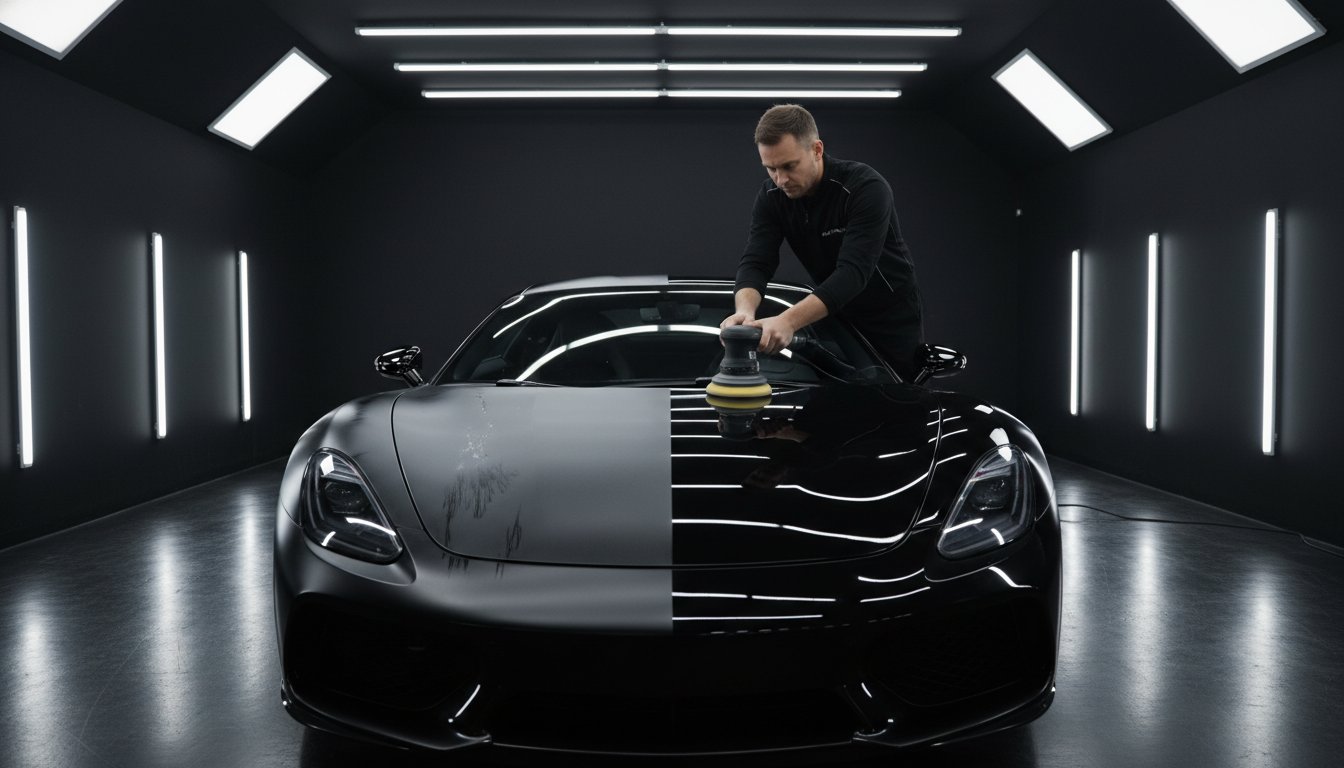
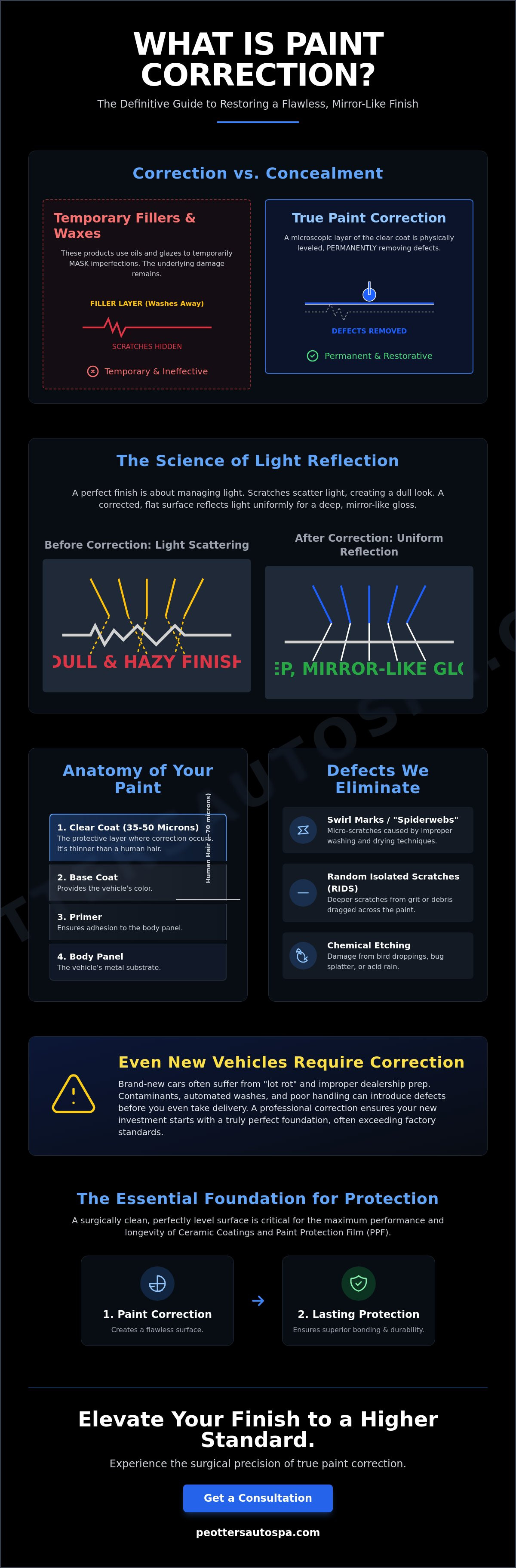
Many vehicle owners mistake a glossy surface for a healthy one, yet a high-shine finish can often hide a multitude of imperfections. To truly understand what is paint correction, one must look past the superficial brilliance of a fresh wax. Authentic paint correction is the methodical, mechanical leveling of the clear coat to eliminate surface defects like swirl marks, bird drop etching, and fine scratches. While retail products often rely on "glazes"—oils and fillers that temporarily mask damage—professional correction involves the physical removal of a microscopic layer of the clear coat. This process restores the paint to a perfectly flat state, allowing light to reflect with absolute precision rather than scattering across jagged edges.
We maintain a "white-glove" standard that relies on specialized, high-intensity LED lighting to reveal what the naked eye misses. These arrays mimic the harshness of direct sunlight, exposing every micro-mar and "cobweb" etched into the finish. By working in this controlled environment, we ensure that the restoration is complete and permanent. The clear coat serves as the essential canvas for this work, and our goal is to refine it until the finish achieves a level of depth and clarity that often surpasses how the vehicle looked on the showroom floor.
Correction vs. Detailing: Understanding the Hierarchy
Standard Auto detailing is an essential practice for maintaining cleanliness and hygiene, but it doesn't address the structural integrity of your paint. A traditional "wash and wax" service cleans the surface and applies a temporary barrier, yet it leaves the underlying damage untouched. Correction is a far more intensive discipline. It focuses on the surface integrity itself, using professional-grade abrasives and precision machinery to reshape the clear coat. This specialized approach requires a master craftsman's touch to balance defect removal with the preservation of the paint's total thickness.
The Anatomy of Your Vehicle's Paint System
Modern automotive finishes are composed of a sophisticated three-layer system: the primer, the base coat which provides the color, and the clear coat. The clear coat is the sacrificial protective layer of a modern paint system. This top layer is remarkably thin, often measuring only 35 to 50 microns on modern vehicles, which is roughly the thickness of a single human hair. Because we only have a limited amount of material to work with, our approach is always conservative and calculated. We measure the paint thickness across every panel to ensure we restore the finish while maintaining the long-term resilience of the vehicle’s protection.
The Science of Surface Defects: What Correction Actually Fixes
Achieving a showroom-quality finish requires an understanding of how light interacts with matter. When light hits a perfectly flat surface, it reflects back at a uniform angle, creating the mirror-like clarity we associate with a brand-new vehicle. However, when light encounters a surface marred by scratches and swirls, it scatters in multiple directions. This diffusion is what makes your vehicle's paint appear dull, hazy, or greyed out. To understand what is paint correction, you must view it as the science of light management. By removing the microscopic peaks and valleys in the clear coat, we restore the surface's ability to reflect light with absolute fidelity.
This restoration process directly influences the Refractive Index of the surface. A smooth, level clear coat allows light to pass through to the base color and return to your eyes without interference, producing a sense of "wetness" and deep gloss. In regions like Springfield, New Jersey, our climate presents unique challenges to this clarity. The combination of coastal humidity, road salt, and industrial fallout creates a high-stakes environment where surface integrity is constantly under siege. Understanding the OEM paint refinishing process is vital for anyone seeking to reverse these environmental effects through professional restoration.
Common Imperfections: From Swirls to Etching
Surface defects generally fall into two categories: above-surface contaminants and below-surface damage. Swirl marks, often called "spiderwebbing," are the most common below-surface defect. These circular micro-scratches usually stem from improper washing techniques or automated car washes. Random Isolated Deep Scratches (RIDS) are more significant, often caused by grit or debris being dragged across the paint. Chemical etching is perhaps the most insidious, as bird droppings or acidic rain can eat into the clear coat, creating permanent craters. If you are seeing these signs, it may be time to explore professional paint correction to preserve your vehicle's aesthetic value and structural integrity.
Oxidation and UV Damage: The Dullness Factor
Continuous exposure to intense UV radiation causes a chemical breakdown in the molecular bonds of the clear coat. This degradation results in oxidation, which manifests as a cloudy, milky, or chalky appearance on the surface. Because the damage is structural, no amount of wax or sealant can fix it. Restoration requires the surgical removal of the dead, oxidized paint to reveal the healthy, vibrant finish underneath. Professional correction is the only way to restore the true depth of the original color, ensuring your vehicle retains its prestige and resale value for years to come.
The Professional Process: A Surgical Approach to Restoration
True automotive restoration is a deliberate and methodical discipline. We approach every vehicle with a "Clean Room" philosophy, ensuring the environment is controlled and free of airborne contaminants that could interfere with the finish. Before any abrasive touches the surface, we perform ultrasonic paint thickness measurements across every panel. This step is non-negotiable. It provides a digital map of your vehicle's clear coat, allowing our specialists to proceed with the confidence that we are preserving the paint’s long-term health. Understanding what is paint correction requires recognizing this initial investigative phase as the foundation of the entire service.
Our commitment to precision means we never guess. By measuring the clear coat in microns, we determine the exact amount of material available for leveling. This data-driven approach prevents the risk of "burning through" the finish, a common danger in high-volume shops. As noted by Forbes on paint correction, this level of technical detail is what separates a professional restoration from a simple cosmetic enhancement. It ensures your investment is handled with the care it deserves.
Decontamination: The Vital First Step
A flawless finish is impossible without a surgically clean surface. We begin with a chemical decontamination process to dissolve iron particles, brake dust, and industrial fallout that standard washing cannot reach. Following this, we perform mechanical decontamination using a clay bar to extract microscopic contaminants embedded deep within the pores of the paint. Polishing a surface that hasn't been properly prepared is a recipe for disaster. It risks trapping grit between the pad and the paint, leading to deep, unsightly scratches. This meticulous preparation ensures the clear coat is ready for the refinement stages.
Compounding and Polishing: The Leveling Stages
The restoration process typically follows a multi-stage path tailored to the vehicle's specific condition. This approach balances the removal of defects with the enhancement of gloss. We utilize a variety of specialized tools to achieve these results:
- Heavy Compounding: This stage utilizes aggressive abrasives to level the clear coat and remove significant defects such as deep swirls, RIDS, or heavy etching.
- Polishing and Refinement: We follow the heavy work with finer polishes to remove any remaining haze and restore the paint's natural clarity and color depth.
- Jeweling: The final step involves ultra-fine finishing to maximize light refraction and create a mirror-like, high-definition gloss.
Our specialists select between Dual Action (DA) and Rotary polishers based on the paint's hardness and the desired outcome. While Rotary machines offer the torque needed for heavy leveling, DA polishers provide the orbital motion required for a perfectly refined finish. For a comprehensive look at how these technical stages influence your restoration investment, you can review our paint correction service cost guide. This tiered approach allows us to match the level of correction to your vehicle's unique needs and your personal standards of perfection.
Why Even New Vehicles Require Surface Correction
The journey from the assembly line to your driveway is rarely a clean one. Most owners assume a fresh odometer reading guarantees a flawless finish, yet the reality of modern manufacturing often tells a different story. Assembly lines can leave behind "pigtails"—tiny, curly sanding marks—and other factory-installed defects that occur during the rapid-fire finishing process. When you consider what is paint correction for a brand-new vehicle, you're looking at the necessary surgical refinement to remove these flaws. Additionally, vehicles spend weeks in transit via rail or open-air truck, collecting industrial fallout and rail dust that embeds itself into the clear coat before the car even reaches the dealership lot.
The Dealership Prep Myth
Dealerships operate as high-volume environments where speed often takes precedence over precision. To prepare a car for delivery, they typically use rapid, automated washes or "express" detailing services that rely on aggressive brushes and reused towels. These methods introduce fine swirl marks and light scratches to the clear coat of a vehicle that hasn't even seen its first oil change. To make the car look acceptable for the hand-off, many dealers apply heavy glazes containing "fillers" that temporarily mask the damage. However, once you inspect the surface under a high-lumen specialist light, the illusion of perfection disappears. It reveals a surface that is dull, hazy, and far from the elite standard you expect from a luxury investment.
Preparation for Permanent Protection
If you plan to shield your investment, correction is the mandatory first step. Applying a ppf and ceramic coating package nj over uncorrected paint is a missed opportunity for true excellence. You never want to "lock in" factory sanding marks or dealership swirls under a permanent layer of protection. Beyond the visual benefits, a surgically leveled surface improves the molecular bond between the paint and the Paint Protection Film (PPF), ensuring maximum adhesion and long-term resilience. This "Total Vehicle Preservation" mindset ensures you correct the surface once and protect that perfection forever. By refining the clear coat now, you create the ideal foundation for a finish that remains breathtaking for years.
If you have recently taken delivery of a new vehicle, schedule a consultation with Peotter’s Auto Spa to ensure your finish meets our uncompromising standards before applying protection.
The Peotter’s Standard: Expert Correction in Springfield
Our legacy in the automotive world began in 1994 with Peotter’s Auto Body. Over the decades, we have evolved from a premier collision center into the modern Peotter’s Auto Spa, where we apply that same foundational knowledge of paint chemistry to the art of surface restoration. When clients ask us what is paint correction, we describe it as a collaborative journey. We don't believe in one-size-fits-all solutions; instead, we utilize a consultative approach to match the level of correction to your vehicle's specific history and your future goals for its appearance. This ensures that every car receives the exact amount of attention it needs to reach its full aesthetic potential.
In Springfield and the surrounding Union County area, vehicles face a unique set of environmental stressors. The heavy application of road salt during New Jersey winters, combined with the industrial fallout common in our region, creates a high-stakes environment for clear coats. These elements don't just sit on the surface; they bond to the paint and accelerate degradation. Our specialists are intimately familiar with these local challenges, tailoring our restoration techniques to combat the specific oxidation and etching patterns seen in our community. For a deeper look at our specific service tiers, we invite you to explore our guide on Expert Paint Correction in Union County, NJ.
Meticulous Master Craftsmanship
We treat every vehicle as a significant investment. Our craftsmen are dedicated to the principle of maximum preservation, meaning we aim to achieve a flawless finish while removing the absolute minimum amount of clear coat. This balance is what separates a true specialist from a high-volume shop. When you drop off your vehicle at our Springfield facility, you're entering a white-glove experience designed for peace of mind. It’s why luxury owners from Summit and across North Jersey trust our precision. We don't just clean cars; we rejuvenate and protect their legacy through uncompromising attention to detail.
Next Steps for Your Vehicle
Determining the right path for your car depends on its current condition and your desired outcome. A one-step enhancement is often ideal for newer vehicles needing a gloss boost, while a multi-stage restoration is required for older finishes with deep defects. Once we restore that showroom clarity, we'll guide you on the proper maintenance techniques to prevent the return of swirl marks. The goal is to ensure your vehicle remains a source of pride for years to come. Your journey toward a perfect finish begins with a professional evaluation. Contact us today to schedule your paint assessment at our Springfield facility and experience the Peotter’s difference firsthand.
Elevate Your Automotive Investment to New Heights
Your vehicle deserves a finish that reflects its true value and your pride of ownership. We have explored what is paint correction as a technical discipline; it moves far beyond simple aesthetics into a higher standard of structural preservation. By choosing a meticulous multi-stage process, you ensure that every swirl, scratch, and oxidation layer is surgically removed to reveal a mirror-like depth that often exceeds factory standards. This refinement is the essential foundation for long-term protection against the harsh New Jersey environment.
Since 1994, our team has served as specialists in luxury and exotic vehicle restoration for owners who refuse to compromise on quality. We combine decades of heritage with a boutique approach to ensure your property receives the elite care it deserves. Restore Your Vehicle's Showroom Shine—Book a Consultation at Peotter's Auto Spa. We look forward to helping you rediscover the breathtaking clarity and brilliance of your vehicle's finish.
Frequently Asked Questions
Is paint correction permanent?
Paint correction is a permanent removal of surface defects because it levels the clear coat to the depth of the scratch. Unlike retail glazes or waxes that merely fill in imperfections with temporary oils, the results of this mechanical restoration don't wash away over time. However, the surface remains susceptible to new damage from improper washing or environmental factors, which is why we recommend following up with a ceramic coating or paint protection film to lock in the perfection.
Will paint correction remove all scratches from my car?
Professional correction can remove the vast majority of surface imperfections, including swirl marks, light scratches, and chemical etching. If a scratch has penetrated through the clear coat and into the base paint or primer, it cannot be safely corrected through polishing alone. Our specialists use precision lighting and tactile inspections to identify which defects can be safely leveled without compromising the long-term integrity of your vehicle's finish.
How long does the paint correction process take?
The duration of the service depends entirely on the condition of the vehicle and the number of correction stages required. A single-stage enhancement may take a full day, while a multi-stage restoration for a heavily weathered luxury vehicle can span two to three days. We prioritize meticulous craftsmanship over speed, ensuring each panel is refined to our uncompromising standards before the vehicle is returned to your care.
Does paint correction thin my car's paint too much?
When performed by a master craftsman, the process removes only a microscopic layer of the clear coat. We utilize digital paint thickness gauges to measure the surface in microns before we begin, ensuring we stay within safe, conservative limits. This data-driven approach preserves the structural integrity of your paint while achieving maximum clarity, protecting the resale value of your significant investment without risking the underlying finish.
Is there a difference between buffing and paint correction?
While the terms are often used interchangeably, what is paint correction involves a much higher degree of precision and technical skill than traditional buffing. Buffing is a generic term for using a machine to increase shine, which often ignores deep defects or hides them with fillers. Paint correction is a systematic, multi-stage restoration that involves decontamination, thickness measurement, and progressive refinement to permanently eliminate flaws and optimize light refraction.
Can I perform paint correction myself at home?
DIY correction is possible but carries significant risks for those without specialized training and professional-grade equipment. Improper technique or the wrong combination of pads and compounds can easily lead to "buffer trails," holograms, or even burning through the clear coat entirely. For luxury and exotic vehicles, the cost of repairing a DIY mistake far exceeds the investment in a dedicated specialist who understands the nuances of different paint systems.
How often should a car undergo paint correction?
You should ideally only need a major paint correction once, provided you follow it with a high-quality ceramic coating or paint protection film. These protective layers act as a sacrificial barrier, preventing new swirl marks and environmental damage from reaching the corrected clear coat. With proper maintenance and "touchless" washing techniques, a professionally corrected finish can maintain its showroom-quality gloss for many years without requiring further abrasive work.
Does paint correction increase the resale value of my car?
A flawless, high-gloss finish significantly enhances the perceived value and desirability of any vehicle, particularly in the luxury and exotic markets. First impressions are critical during a sale, and a surface free of swirl marks and oxidation signals to a buyer that the vehicle has been meticulously maintained. Investing in what is paint correction often yields a high return by ensuring your car stands out as a pristine, well-preserved example of its model.